Choosing among China’s top rubber prototyping companies takes more than comparing prices or polished product photos. Buyers need to know how a supplier handles material selection, sample revisions, dimensional checks, and communication. A rubber seal that looks right on a screen may still deform under compression or fail to fit its housing. Small details matter.
Design expert Donald Norman offers a useful principle: “Good design is actually a lot harder to notice than poor design, in part because good designs fit our needs so well that the design is invisible.” This is not a statement about rubber manufacturing specifically, but it applies to prototype evaluation. A useful prototype should reflect the product’s real purpose, not merely look convincing in a photograph. Fit matters. So does repeatability.
This guide introduces ten companies for buyers exploring rubber prototyping in China. It considers practical factors such as prototyping methods, material options, sample support, quality processes, and suitability for different project stages. Silicone, EPDM, and NBR serve different needs; no single material is automatically best. Ask suppliers how they verify dimensions and whether they can explain trade-offs in plain language. That takes testing. A company profile can help narrow a search, but it cannot replace a drawing review, sample inspection, or direct discussion with the supplier. Rankings also have limits, and capabilities can change. Use this list as a starting point, then confirm that each candidate fits your part, timeline, and production goals.
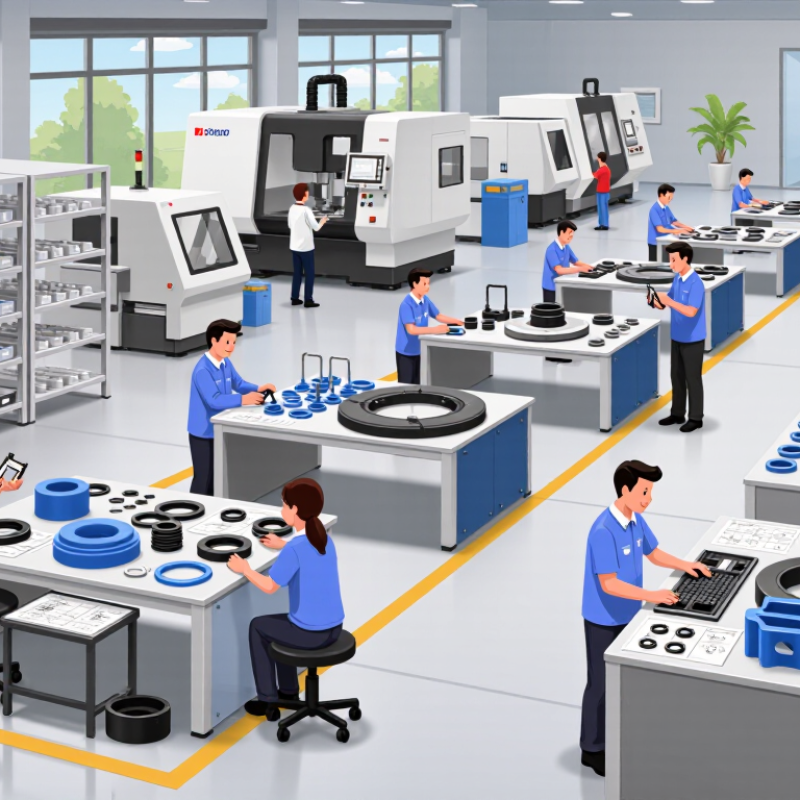
Rubber prototyping turns a drawing into a testable part, often through molded samples, cast elastomers, or machined rubber blanks. Engineers use prototypes to check hardness, compression, rebound, sealing, and fit before committing to production tooling. A small gasket around a metal housing can reveal leaks, uneven compression, or a poor groove design. Material choice matters: silicone handles heat well, while EPDM is commonly selected for weather and water exposure. These are starting points, not guarantees. A prototype made with a different process may behave differently from the final molded part.
Applications range from automotive seals and vibration pads to medical equipment components, appliance feet, and industrial hoses. Grand View Research reported that the global medical devices market was valued at USD 512.29 billion in 2022, reflecting the scale of a sector that depends on reliable component testing. That figure is not specific to rubber, but it helps explain why material validation matters. Prototype tests can include compression set, tear strength, and repeated flexing under expected temperatures. A quick bench test helps. It is not enough. Real-world fluids, load cycles, and aging can expose weaknesses that a clean laboratory sample misses, so test conditions should reflect actual use as closely as possible.
A vendor-neutral overview of ten common prototyping processes, their materials, applications, and buyer considerations. The rows describe processes, not ranked companies.
| No. | Prototyping process | Typical material | Common uses | What buyers should check |
|---|---|---|---|---|
| 1 | Flexible 3D printing | TPU or other printable TPE | Early fit-and-form parts, flexible housings, covers, and concept models | Printed elastomers are useful for evaluation but may not match the tear strength, compression set, or aging behavior of molded vulcanized rubber. |
| 2 | Elastomer casting in a prototype mold | Cast silicone or polyurethane elastomer | Low-volume flexible covers, grips, seals, and appearance models | Confirm the exact casting material and whether its hardness and chemical resistance represent the intended production material. |
| 3 | Compression molding | Uncured rubber compounds, such as silicone, EPDM, or NBR | Gaskets, pads, diaphragms, and relatively simple molded components | Ask about the compound grade, cure conditions, parting-line location, flash, and dimensional tolerances. |
| 4 | Transfer molding | Uncured rubber compounds, including silicone and general-purpose elastomers | Small or detailed molded parts, including parts with inserts | Review insert positioning, cavity details, gate or runner marks, and how the prototype tooling supports design changes. |
| 5 | Rubber injection molding | Production rubber compounds such as EPDM, NBR, or silicone | Seals, grommets, vibration-control parts, and geometrically complex components | Check whether the prototype uses production-representative material and molding conditions; prototype tooling may differ from production tooling. |
| 6 | Liquid silicone rubber (LSR) molding | Two-part liquid silicone rubber | Flexible seals, keypads, protective components, and parts requiring fine details | Specify hardness, color, relevant regulatory requirements, and whether the part needs post-curing or special surface treatment. |
| 7 | Extruded profile sampling | Commonly EPDM, silicone, or other specified extrusion-grade compounds | Door and window seals, tubing, edge trims, and continuous sealing profiles | Provide a cross-section drawing and check profile dimensions, cut length, splice quality, and the compound’s intended environment. |
| 8 | Die-cut sheet prototypes | Commercial rubber sheet, such as silicone, EPDM, or NBR | Flat gaskets, washers, isolation pads, and simple sealing components | Confirm sheet thickness, hardness, cut-edge quality, and whether the selected sheet grade meets the service requirements. |
| 9 | Rubber-to-metal bonding | Molded rubber bonded to a prepared metal insert | Vibration mounts, bushings, bonded seals, and isolators | Assess bond integrity, insert preparation, alignment, and performance under the expected load and environment. |
| 10 | Elastomer overmolding | TPE, LSR, or a compatible molded rubber over a rigid substrate | Soft-touch grips, protective edges, sealed interfaces, and two-material parts | Verify material compatibility, mechanical interlocks or bonding method, substrate preparation, and the interface design. |
When evaluating rubber prototyping companies in China, look beyond quoted price and delivery time. Ask how each supplier selects materials, controls molding conditions, and checks finished parts. A useful discussion should cover rubber type, hardness, shrinkage, and the intended working environment. For example, a seal used near oil needs different material considerations from a soft grip exposed to sunlight.
Request a sample made with the proposed material and process. Measure its dimensions, inspect edges for flash, and note whether the surface feels consistent across the part. Small details matter. Ask for inspection records, stated tolerances, and a clear explanation of what the prototype can and cannot represent. A prototype made with a different process may not predict production performance accurately. That limitation is easy to overlook.
Communication is part of the evaluation. Share a drawing with critical dimensions marked, then see whether the supplier raises practical questions about draft, wall thickness, or parting lines. Compare answers, not just promises. If a response is vague, ask for a specific test or sample revision. Even careful reviews can miss something; an early physical trial often exposes assumptions that looked fine on screen.
China’s Top 10 Rubber Prototyping Companies for Buyers
Choosing among China’s top rubber prototyping companies starts with the part’s real job. A soft seal, a vibration pad, and a flexible grip need different material behavior. Share drawings, target dimensions, operating temperatures, and expected compression with each supplier. Ask which process suits the design, such as silicone casting, compression molding, or a flexible additive prototype. A polished sample is useful. Test it under realistic conditions, too.
Compare more than the quoted price. Request material data, tolerances, inspection details, and photos of comparable work. For a seal, check compression set and leakage; for a grip, inspect surface texture and tear resistance. Ask whether the supplier can make a small trial batch before scaling production. Clear answers matter. So does traceability. If a specification is missing, say so instead of treating an estimate as a guarantee.
A top-ten shortlist should reflect your priorities, not just search rankings. Compare response speed, engineering feedback, sample lead time, and how changes are handled. Keep the same drawing and test criteria for every quote. That makes differences easier to judge. One imperfect detail can still teach you something: a prototype that feels right may fail after repeated compression. Build time for revision into the schedule, and record what each test reveals.
Shore A hardness ranges vary by formulation and supplier. Use these indicative material-grade ranges for initial comparison, and confirm exact specifications with the supplier before selecting a prototype material.
When comparing China’s top 10 rubber prototyping companies, look beyond the quoted unit price. Ask which material matches the part’s real job: silicone handles heat well, while NBR is often selected for oil exposure. EPDM may suit outdoor use, but the grade and formulation matter. A supplier should explain hardness, shrinkage, and test conditions, not just send a sample card.
Process choice affects both cost and lead time. Silicone casting can suit small batches and detailed shapes; compression molding may be economical for repeat samples. Additive elastomer printing can check fit quickly, though its surface and mechanical behavior may differ from molded rubber. Fit matters. A fast sample is not proof of production performance, and that distinction is easy to overlook.
Tips: Send a dimensioned drawing, expected quantity, working temperature, and a clear description of chemical or weather exposure. Request a first-article inspection with measured dimensions and hardness. Compare lead times by stage: material sourcing, tooling, sampling, and revisions. Ask whether tooling fees are separate from piece prices. If a supplier cannot explain its assumptions, the low quote may hide a mismatch. Allow time for one revision; prototypes rarely get every detail right on the first pass.
Selecting a Chinese rubber prototyping supplier starts with the part, not the price. Send a controlled drawing that states material, hardness, tolerance, finish, and expected quantity. Ask whether the quote covers tooling, sample revisions, and inspection. A low unit price may hide costly mold changes.
Ask for evidence. Request a material datasheet, lot traceability, and inspection results from a recent comparable part. For a molded seal, check dimensions after curing, hardness, and compression set; for a flexible housing, review tear strength and surface defects. Arrange a sample run before approving production. During a video or on-site audit, compare the actual press, mold storage, and measuring tools with the supplier’s claims. Small details matter.
Grand View Research estimated the global rubber market at about USD 46.7 billion in 2023 and forecast 4.8% annual growth through 2030. Wohlers Report 2024 recorded 11.1% growth in the broader additive manufacturing industry in 2023. These figures show expanding demand and prototyping options, not supplier quality. A report cannot verify one factory.
I would also recheck the first article after any material or process change; that step is easy to overlook.
| Cookie | Duration | Description |
|---|---|---|
| cookielawinfo-checkbox-analytics | 11 months | This cookie is set by GDPR Cookie Consent plugin. The cookie is used to store the user consent for the cookies in the category "Analytics". |
| cookielawinfo-checkbox-functional | 11 months | The cookie is set by GDPR cookie consent to record the user consent for the cookies in the category "Functional". |
| cookielawinfo-checkbox-necessary | 11 months | This cookie is set by GDPR Cookie Consent plugin. The cookies is used to store the user consent for the cookies in the category "Necessary". |
| cookielawinfo-checkbox-others | 11 months | This cookie is set by GDPR Cookie Consent plugin. The cookie is used to store the user consent for the cookies in the category "Other. |
| cookielawinfo-checkbox-performance | 11 months | This cookie is set by GDPR Cookie Consent plugin. The cookie is used to store the user consent for the cookies in the category "Performance". |
| viewed_cookie_policy | 11 months | The cookie is set by the GDPR Cookie Consent plugin and is used to store whether or not user has consented to the use of cookies. It does not store any personal data. |