Get an instant quote
Get in touch Listen to our podcast

Blog

What Are the Top Types of Complete Motors?

A “complete motor” is more than a power rating on a label. It is a working assembly whose motor, controls, mounting, and intended load must suit the job. In this guide, we compare the leading types: AC induction motors, synchronous motors, brushed and brushless DC motors, servo motors, stepper motors, and geared motors. Each behaves differently when starting, changing speed, or handling resistance. The best choice depends on the application—not on a single claim that one design is always superior.

Motor engineer and author Austin Hughes has written extensively about electric motors and drives. A concise paraphrase of a key selection principle from his work is: “Match the motor to the load, operating cycle, and control requirements.” This is a paraphrase, not a direct quotation. Consider a conveyor that runs steadily, a robotic joint that must stop precisely, or a small device that needs strong starting torque. Those details can point to different motor types. Small details matter. So do heat, noise, available space, and maintenance access. A catalog description may not reveal how a motor performs in a real installation. Even experienced buyers can overlook that gap. The sections ahead explain what each common type does well, where its limits appear, and which practical questions to ask before choosing a Complete Motor.
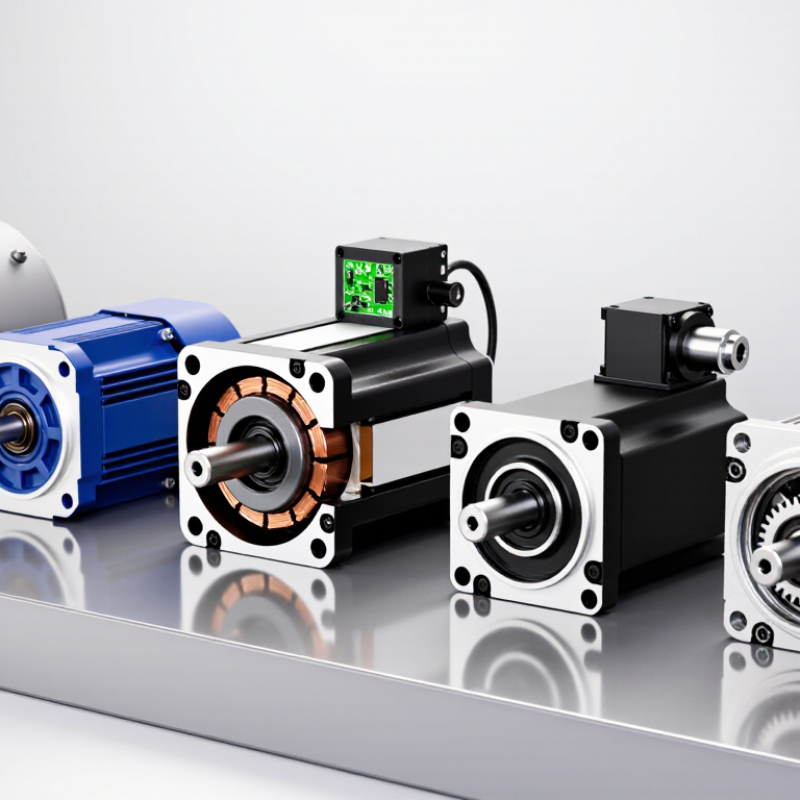
What Are the Top Types of Complete Motors?

How Complete Motors Are Classified

What Are the Top Types of Complete Motors?
How Complete Motors Are Classified

Complete motors are commonly classified by how they convert electrical energy into motion. AC motors run on alternating current, while DC motors use direct current. Within these groups, designs differ in speed control, starting behavior, and maintenance needs. A single-phase AC motor often suits smaller equipment, such as a workshop fan. Three-phase motors are common in industrial settings, where steady operation matters.

Construction offers another useful way to classify them. Induction motors use electromagnetic induction to turn the rotor; synchronous motors run in step with the supply frequency. Enclosure type matters, too. An open motor allows airflow through its housing, while a totally enclosed design helps limit dust and moisture exposure. Neither is universally better. The right choice depends on the environment and cooling requirements.

Motors can also be grouped by mounting style, rated output, and duty cycle. A flange-mounted unit may fit a pump directly, while a foot-mounted motor can sit on a baseplate. Check the nameplate for voltage, frequency, power, and speed before matching a motor to machinery. Small details matter. Classification labels are helpful, but suppliers may use them differently, so confirm what components are included in a “complete motor.” This boundary is not always neat.

What Are the Top Types of Complete Motors? - How Complete Motors Are Classified

Motor Type Energy Source How It Works Key Characteristics Common Applications
Gasoline Internal Combustion Motor Petrol (gasoline) Ignites a compressed air–fuel mixture with a spark plug to produce power. Typically uses spark ignition; available in several cylinder layouts and displacements. Emissions and fuel use depend on design and operating conditions. Passenger cars, light commercial vehicles, motorcycles, and small equipment.
Diesel Internal Combustion Motor Diesel fuel Compresses air until it becomes hot enough to ignite fuel injected into the cylinder. Uses compression ignition and is commonly designed for strong low-speed torque. Requires a fuel-injection system and diesel-specific emissions controls. Trucks, buses, some passenger vehicles, agricultural machinery, and industrial equipment.
Battery-Electric Motor Electricity stored in a rechargeable battery Electrical energy drives an electric machine, which turns the vehicle’s wheels through a drivetrain. Produces no tailpipe exhaust during operation and can deliver torque from low speeds. Range depends on battery capacity, conditions, and vehicle efficiency. Battery-electric cars, buses, delivery vehicles, and industrial vehicles.
Hybrid Motor System Liquid fuel and electricity Combines an internal combustion motor with one or more electric machines; the system manages their use according to its design. May recover some braking energy. Conventional hybrids recharge their batteries onboard, while plug-in hybrids can also charge from an external power source. Passenger cars, SUVs, and some commercial vehicles.
Natural Gas Motor Compressed or liquefied natural gas Burns natural gas in a purpose-designed or adapted internal combustion motor. Requires fuel storage and delivery components designed for gas. Fuel availability and storage requirements influence vehicle suitability. Transit buses, refuse trucks, fleet vehicles, and some stationary power applications.
Hydrogen Fuel-Cell Electric System Hydrogen A fuel cell converts hydrogen and oxygen into electricity, which powers an electric motor. Electric drive with water as the principal tailpipe product during normal fuel-cell operation. Requires hydrogen storage and access to refueling infrastructure. Some passenger vehicles, buses, and heavy-duty vehicle applications.

Classification is based on the motor’s primary energy source and power-generation method. A complete motor assembly may include different components depending on its design and intended application.

AC Motors: Induction and Synchronous Designs

AC motors are common in complete motor assemblies because they use alternating current and offer practical options for steady, continuous work. Induction motors create rotor current through the magnetic field generated by the stator. The rotor turns slightly slower than that field, a difference called slip. This simple design suits pumps, fans, and conveyors that need dependable operation. It also handles dusty, busy environments well, though heat and vibration still need monitoring. A practical trade-off.

Synchronous motors keep their rotor aligned with the rotating magnetic field, so their speed stays closely tied to the supply frequency. That makes them useful where precise, consistent speed matters, such as in certain compressors or process equipment. Some designs use permanent magnets; others use electrically excited rotors. Their controls and starting arrangements can be more involved than those of induction motors. Not always obvious. When comparing options, check the load, required speed stability, supply conditions, and maintenance capacity. A motor that looks efficient on paper may not suit a site with frequent starts or changing loads.

What Are the Top Types of Complete Motors? — AC Motors: Induction and Synchronous Designs

For a four-pole motor, synchronous speed is 1,500 rpm at 50 Hz and 1,800 rpm at 60 Hz. An induction motor typically runs somewhat below synchronous speed under load because of slip; actual speed varies with motor design and load. A synchronous motor runs at synchronous speed while it remains in step with the AC supply.

DC Motors: Brushed and Brushless Designs

Brushed and brushless DC motors both convert direct current into rotation, but they manage commutation differently. In a brushed motor, carbon brushes contact a rotating commutator to switch current through the windings. The design is straightforward, and speed control can be simple. Yet those contacts wear down, create friction, and may produce electrical noise. In a compact motor running for long hours, brush life can become a maintenance issue. Small details matter.

Brushless DC motors use electronic controllers to switch current, usually based on rotor position. They avoid brush contact, which can reduce routine wear and support efficient operation. The trade-off is a more complex controller, and sensor-based designs may need extra wiring. The International Energy Agency’s 2011 report, Energy-Efficiency Policy Opportunities for Electric Motor-Driven Systems, estimates motor-driven systems use 43–46% of global electricity. That broad figure is not a direct comparison of DC motor types, but it shows why choosing an appropriately sized, efficient motor matters. Match the motor to its load, speed range, duty cycle, and operating environment. A common oversight is focusing only on rated power; startup torque and heat buildup also deserve attention. There is no universal winner. The right choice depends on the whole system, not just the motor.

Precision Motors: Servo and Stepper Designs

Servo and stepper motors solve different motion problems. A servo uses feedback to correct position, speed, or torque as conditions change. A stepper moves in fixed increments, making it useful for repeatable, lower-speed tasks where the load is predictable. Neither is automatically more precise: performance depends on the motor, drive, control settings, and mechanical setup.

The U.S. Department of Energy’s Improving Motor and Drive System Performance: A Sourcebook for Industry reports that motor-driven systems use about 68% of electricity in U.S. manufacturing. That figure covers many kinds of industrial motors, not servos or steppers alone. Still, it highlights why choosing the right motor and tuning its drive can matter beyond motion accuracy.

In practice, a servo may suit a fast pick-and-place axis that must recover from changing loads. A stepper can work well for a small indexing table with steady resistance. One caveat: a sizing spreadsheet may miss friction from a stiff coupling or a warm bearing.

Tips: Check required torque at operating speed, not just holding torque. Test the actual load, acceleration, and duty cycle; a motor that works on paper may skip steps or overheat in the machine.

How to Select a Motor Type for the Application

Choosing a motor starts with the load, not the catalog. A conveyor carrying uneven boxes needs strong starting torque and steady operation; a small positioning axis may need precise control instead. The International Energy Agency’s 2011 report, Energy-Efficiency Policy Opportunities for Electric Motor-Driven Systems, estimated that motor-driven systems use about 46% of global electricity. That scale makes efficiency important, but the best choice still depends on the machine.

For constant-speed industrial duties, an induction motor is often a practical, rugged option. Add a variable-speed drive when flow or speed must change; throttling a pump while the motor runs flat out can waste energy. Permanent-magnet synchronous motors can offer high efficiency and compact size, but check drive compatibility and operating conditions. Servo motors suit fast, accurate motion. Stepper motors can work for simpler positioning, though missed steps under changing loads are a real risk. Small details matter.

Compare starting torque, speed range, duty cycle, enclosure, supply voltage, and maintenance access. The U.S. Department of Energy’s 2014 motor-and-drive systems sourcebook emphasizes evaluating the whole system, rather than selecting a motor in isolation. Measure the actual load if possible: a nameplate rating is not a full duty profile. I still find this easy to underestimate. A motor sized for a brief peak may run inefficiently during ordinary operation, while an undersized unit can overheat during repeated starts. Check the drive, coupling, and cooling together before settling on a type.

CNC machining CAD export file formats

Put your parts in production today

Get an instant quote