China’s sintered-stone sector is shaped by large production lines, dense supplier clusters, and fast-changing design demand. Sintered Stone Slabs may look similar in showroom lighting, but performance can differ in thickness control, surface consistency, and edge quality. Small details matter. A slab’s flatness, veining repeatability, and packaging can affect installation and breakage risk.
Industry reports help set the context, but they do not provide a definitive supplier ranking. Grand View Research’s Ceramic Tiles Market report tracks broader ceramic-market demand, while China’s National Bureau of Statistics publishes data on building-materials production and industrial activity. Neither source isolates sintered stone suppliers as a separate category. Customs data also groups many ceramic products under wider product codes. That limitation matters. This guide therefore compares manufacturers through practical evidence: product range, factory capabilities, export experience, quality systems, and publicly available company information. Buyers should verify current certifications, inspect recent production samples, and confirm slab dimensions and lead times directly. A polished catalogue is useful, but it is not proof of consistent delivery. The strongest supplier is not always the largest; it is the one whose documented capacity and quality match the project. Could rankings change? Certainly. Supplier performance, product lines, and market conditions shift over time.
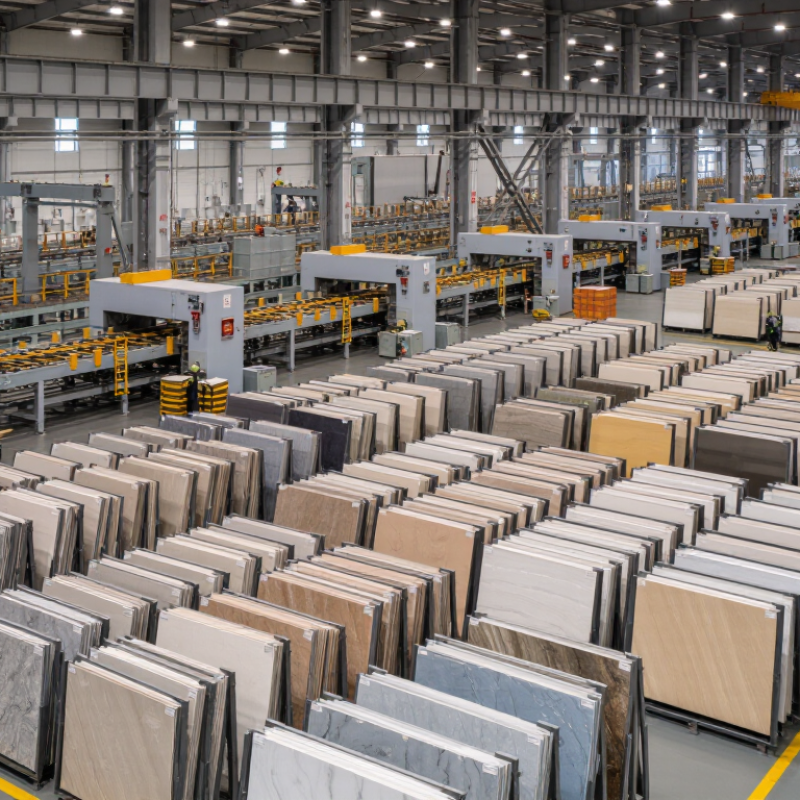
China’s sintered stone slab industry covers manufacturers and suppliers of large-format surfaces made by compacting mineral-based materials and firing them at high temperatures. The category is commonly segmented by product format, thickness, surface finish, and intended use. A polished slab for a kitchen island has different practical requirements from a textured panel used on a wall.
Suppliers also differ in their role. Some operate production facilities, while others focus on export, distribution, or project supply. Product segments often include slabs for countertops, flooring, wall cladding, and furniture surfaces. Buyers should compare dimensions, edge-processing options, finish consistency, and available technical documentation. These categories are helpful, but not perfectly clear-cut: one supplier may serve several uses, and product descriptions can vary.
Tips: Ask for a current specification sheet and inspect a physical sample. Check thickness tolerance, stain and heat guidance, and whether the sample represents the production batch. Small differences matter. A glossy showroom sample alone may not reveal how a large installed surface will look.
Sintered stone slabs are commonly segmented by thickness, application, surface finish, and format. Typical thickness options include 3, 6, 9, 12, 15, and 20 mm; thinner products are often used for wall cladding, while thicker slabs are commonly selected for countertops and other demanding surfaces. Options vary by product line. This chart shows product specifications, not supplier rankings or market shares.
China’s major sintered stone suppliers generally combine large-scale production with export experience, technical support, and broad slab selections. The China Building Ceramics & Sanitaryware Association reported national ceramic-tile output of about 5.97 billion square metres in 2022. That figure describes the wider tile industry, not sintered stone alone, so it should not be mistaken for slab production data. Still, it shows the manufacturing depth behind China’s surface-material supply chain.
For buyers comparing established suppliers, factory capacity matters, but so does consistency between batches. Ask for slab thickness tolerances, flatness records, technical data sheets, and recent inspection results. Check full-size samples under natural light; small chips, cloudy patches, or colour shifts can disappear in a catalogue. Ask how slabs are packed for shipment, too.
Cracked corners are costly.
Industry reports rarely separate sintered-stone volumes from other ceramic products, which makes supplier claims harder to compare. That gap is worth questioning. A careful buyer should verify production records and inspect finished slabs before placing a large order.
Large sintered stone slabs are commonly sold in thicknesses from 6 to 20 mm, but dimensions vary by supplier and production line. Formats around 3200 × 1600 mm are often available; confirm the actual slab size before planning seams. A large panel can reduce visible joints, yet it also needs careful handling and suitable access through doors and lifts. That matters.
At 6 mm, slabs are light and useful for wall cladding, cabinet fronts, and renovation overlays. Their lower weight can simplify installation, but the substrate and fixing method still need to match the product specifications. Thicknesses around 9–12 mm offer more substance for floors and some worktops, subject to the maker’s technical data and local installation conditions. A 20 mm slab gives a thicker edge profile and is commonly chosen for kitchen counters or vanities. It is heavier, so support and transport deserve attention.
Finishes change both appearance and upkeep. Polished surfaces reflect light and show veining clearly, while matte finishes soften glare and can feel calmer underfoot. Textured finishes add grip, though dirt may settle into their relief. Not always. I would compare a sample in the room’s actual light; photographs rarely show the full effect. Also check stain, heat, and slip-performance data rather than judging a slab by thickness alone. A small sample can still mislead.
When comparing sintered stone slab suppliers in China, ask for test reports tied to the exact slab thickness and finish. Under EN 14411, BIa classification indicates water absorption of no more than 0.5%. That figure matters in kitchens and bathrooms, where spills can sit on the surface. A low result supports resistance to water uptake, but it does not prove every performance claim.
Check the report’s test method, date, sample identification, and laboratory details. The stated strength benchmark should be at least 35 MPa for modulus of rupture, also called bending strength. “Modulus” alone can be ambiguous; elastic modulus is a different property. Small wording errors happen, but they deserve clarification before ordering. Ask whether the tested piece matches the production slab, not just a specially prepared sample.
Numbers need context. A thin slab may perform differently from a thicker one during handling, cutting, or installation. Request data for the intended thickness, plus guidance on support spacing and edge treatment. Inspect a full-size sample under natural and angled light; tiny chips near a cut edge can reveal practical limits. I would not judge a supplier by one certificate alone. Documentation helps, yet consistent batches and careful packaging matter too. A second test may be worthwhile when reports seem incomplete.
A supplier’s claimed capacity should match its equipment, staffing, and recent production records. Ask for monthly output by slab thickness, not one impressive total. During a factory visit, compare machine schedules with finished slabs and packing areas. Photos are not proof. Check whether certificates name the actual factory and product category, and verify dates with the issuing body. Ask for recent third-party test reports, with methods and results clearly stated. Standards can differ by material, so confirm the test method fits the slab.
Request full-size samples when possible. A small polished tile may hide shade variation, edge chipping, or warping across a large slab. Compare samples under daylight and warm indoor lighting. Record the finish, thickness, batch number, and packaging details. One sample is not enough. Ask for repeat samples from another production batch; consistency can be the weak point, even at a capable factory.
Export support deserves the same scrutiny as manufacturing. Request a sample packing list, crate photos, loading plan, and written details on lead times and damage claims. The World Bank’s 2023 Logistics Performance Index assessed 139 economies across six dimensions, including customs, shipment tracking, and delivery timeliness. Use those measures to frame practical questions: who handles export documents, how are crates identified, and when does the supplier share tracking updates? Vague answers are a warning, though not proof of poor performance.
This is a supplier-screening scorecard, not a verified ranking. No supplier-specific capacity, certification, or performance claims are made here. Compare shortlisted factories using current documents and independent checks; record results in the final column.
| Verification area | Evidence to request | How buyers can verify it | Practical pass condition | Buyer record |
|---|---|---|---|---|
| Factory identity and site | Business registration details, factory address, production-line list, and a live factory walkthrough. | Match the registered legal entity and address against official business records. Confirm that the walkthrough shows the stated production site and equipment. | The legal entity, site address, and party named on the quotation and contract are consistent. | Not yet verified |
| Production capacity | Current line count, operating shifts, typical monthly output, slab-size range, and recent production records. | Request a live video inspection or independent factory audit. Compare capacity claims with machinery, staffing, production schedules, and recent shipment records. | Capacity is supported by observable equipment and records, and the proposed schedule fits the order quantity. | Not yet verified |
| Quality control | Written inspection procedures, batch traceability, inspection records, and the supplier’s process for handling defects. | Review a recent batch record and ask how slab dimensions, surface appearance, and other agreed specifications are checked and documented. | Inspection criteria are documented, tied to identifiable batches, and agreed before production. | Not yet verified |
| Certifications and declarations | Copies of relevant management-system certificates and product-specific test reports or declarations, where applicable. | Check the certificate number, holder, scope, issuing or certification body, and validity directly with the issuer or its official verification service. Confirm reports cover the product being purchased. | Documents are current, authentic, and applicable to the named factory, product, and intended market. Do not treat a certificate as proof of every product claim. | Not yet verified |
| Samples and product match | Physical samples, finish and color references, technical specifications, and a written sample-approval record. | Compare the approved sample with production photos and, where possible, a pre-shipment inspection sample. Confirm acceptable variation limits in writing. | The buyer approves a clearly identified reference sample and records the agreed tolerances before mass production. | Not yet verified |
| Packaging and shipping readiness | Export packing specification, loading photos, packaging details, and proposed shipping terms. | Review packing and loading evidence from comparable shipments. Confirm packaging responsibilities and risk allocation in the sales contract and agreed Incoterm. | Packing is suitable for the shipment route, and responsibilities, inspection timing, and delivery terms are documented. | Not yet verified |
| Export documentation | Sample commercial invoice, packing list, bill-of-lading details, and any origin or product documents required for the destination. | Ask a freight forwarder or customs broker to review the proposed document set against the destination country’s current import requirements. | The supplier can prepare the agreed documents accurately and by the required shipping deadlines. | Not yet verified |
| Communication and after-sales support | Named order contact, response process, complaint procedure, and written warranty or remedy terms. | Test response times during sampling and contract review. Check that defect reporting, evidence requirements, and remedies are stated in writing. | Responsibilities and response steps are clear, documented, and included in the purchase agreement. | Not yet verified |
| Commercial and payment risk | Itemized quotation, production lead time, payment schedule, inspection terms, and contract details. | Verify the beneficiary name against the contracting entity. Have an independent inspector check goods before final payment when appropriate. | Pricing and milestones are transparent, and payment terms are linked to clearly defined order and inspection requirements. | Not yet verified |
| Cookie | Duration | Description |
|---|---|---|
| cookielawinfo-checkbox-analytics | 11 months | This cookie is set by GDPR Cookie Consent plugin. The cookie is used to store the user consent for the cookies in the category "Analytics". |
| cookielawinfo-checkbox-functional | 11 months | The cookie is set by GDPR cookie consent to record the user consent for the cookies in the category "Functional". |
| cookielawinfo-checkbox-necessary | 11 months | This cookie is set by GDPR Cookie Consent plugin. The cookies is used to store the user consent for the cookies in the category "Necessary". |
| cookielawinfo-checkbox-others | 11 months | This cookie is set by GDPR Cookie Consent plugin. The cookie is used to store the user consent for the cookies in the category "Other. |
| cookielawinfo-checkbox-performance | 11 months | This cookie is set by GDPR Cookie Consent plugin. The cookie is used to store the user consent for the cookies in the category "Performance". |
| viewed_cookie_policy | 11 months | The cookie is set by the GDPR Cookie Consent plugin and is used to store whether or not user has consented to the use of cookies. It does not store any personal data. |