Get an instant quote
Get in touch Listen to our podcast

Blog

Top MAG Welding Machine Brands for Global Buyers

Choosing a Mag Welding Machine for international purchasing involves more than comparing amperage ratings and familiar logos. A machine that performs well in a demonstration may struggle with your production schedule, available power, or local service options. Details matter. For buyers welding structural steel, vehicle components, or sheet metal assemblies, consistent wire feeding directly affects weld quality and rework. MAG welding uses active shielding gases, commonly carbon dioxide or argon-based mixtures, making gas compatibility an essential purchasing consideration.

Brands such as Lincoln Electric, Miller, ESAB, Fronius, and Kemppi provide useful starting points for comparison across different industrial requirements. Their product ranges differ, so brand reputation alone cannot establish which model suits a particular workshop. Check the rated duty cycle at your intended welding current, alongside input voltage, wire diameter range, and feeder configuration. Ask suppliers to demonstrate arc stability on material matching your actual thickness and joint design. For a fabrication shop running long shifts, accessible contact tips and replacement feed rollers can matter more than extra programs. Service matters too.

This guide examines leading MAG welding machine brands through practical purchasing criteria, including application fit, technical documentation, support availability, and ownership costs. There is no universal winner, and even a detailed specification comparison leaves questions that only a representative welding trial can resolve. A lower purchase price may be attractive, but overseas freight and delayed repairs can change the calculation. We may also give familiar brands too much credit. Buyers should verify regional warranty terms, applicable certification documents, and distributor capabilities before committing to an order.
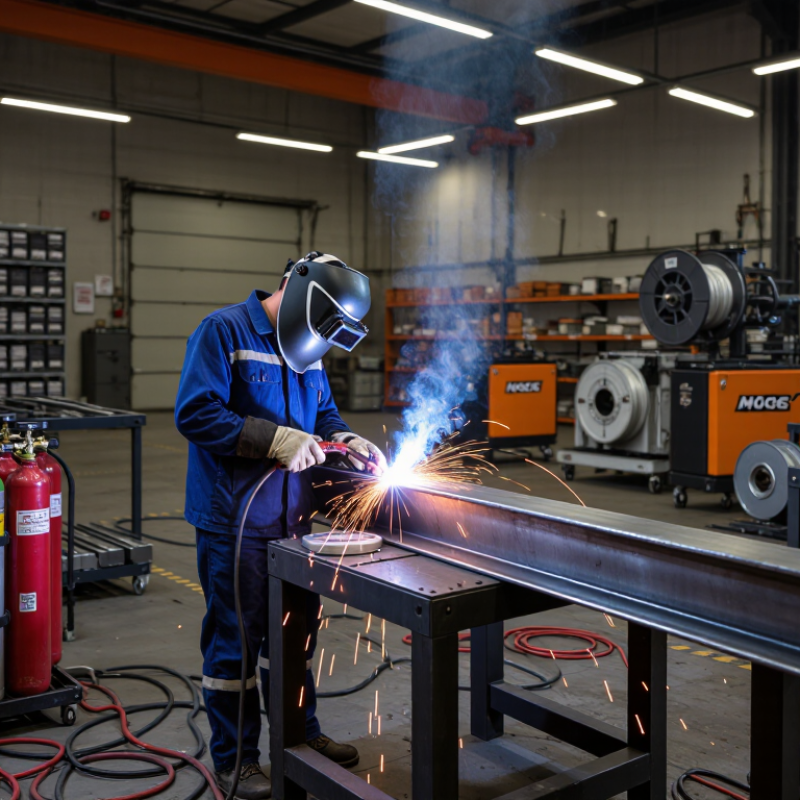
Top MAG Welding Machine Brands for Global Buyers

MAG Welding Fundamentals: ISO 4063 Processes 135, 136 and 138

MAG welding covers three distinct ISO 4063 processes, not one interchangeable setting. Process 135 uses a solid wire electrode with active shielding gas. Process 136 uses a flux-cored wire and active gas; its slag and arc behavior differ from solid-wire welding. Process 138 uses metal-cored wire with active gas, combining a tubular electrode with a metal-rich core. ISO 4063:2023 provides the process numbering, while the actual procedure still depends on material, joint design, position, and inspection requirements.

The scale of steel fabrication is considerable: World Steel Association’s World Steel in Figures 2024 reports 1,892.2 million tonnes of crude steel produced worldwide in 2023. That figure describes steel output, not MAG process use, but it helps explain why reliable, repeatable joining matters across fabrication shops. In practice, compare wire-feed stability, gas coverage, fume extraction, and access to the joint. A draft across a shop floor can disturb shielding gas. Small details matter.

Higher deposition rates can improve productivity, but they do not guarantee better welds. Process 136 may suit applications where slag formation is acceptable; 135 often offers a clean bead with less post-weld cleanup. Process 138 can provide useful deposition characteristics, yet consumable choice and parameter control remain critical. A polished bead is not proof of sound fusion. Process labels alone are not enough; qualified procedures and inspection should guide the final choice.

Leading MAG Brands: ESAB, Lincoln Electric, Miller, Fronius and Kemppi

Global buyers comparing leading MAG machine makers should look beyond headline amperage. Arc stability, wire-feed control, and duty cycle at the required output matter more on a production floor. A steady weld bead across a long seam saves rework; inconsistent feeding does not. MarketsandMarkets’ 2023 welding-equipment report estimated a global market of $17.2 billion, projecting $21.3 billion by 2028. That growth signals broad demand, not equal performance from every supplier. Fit matters more.

Compare the five established international suppliers by application, not reputation alone. Check whether synergic programs suit your wire diameter and shielding gas, then test starts, stops, and thin-sheet control on real workpieces. Not just amperage. Ask about local service response, spare-part availability, and training; a capable machine can still disappoint when a feeder board is unavailable. The American Welding Society’s 2023 workforce data projected demand for 360,000 additional welding professionals by 2027, making simple setup and repeatable results valuable. Still, that figure measures workforce need, not machine quality. A practical trial remains essential, and my own comparison would be incomplete without one.

MAG Shielding Gas Mixes: Typical Composition by Volume

Representative gas blends used in metal active gas (MAG) welding. The percentages show the volume share of each gas.

Gas choice can influence arc stability, spatter, and weld penetration. The best mix depends on the material, transfer mode, and welding procedure; always follow the applicable welding procedure specification.

Comparing Rated Output and 10-Minute Duty Cycles Under IEC 60974-1

Top MAG Welding Machine Brands for Global Buyers

Comparing Rated Output and 10-Minute Duty Cycles Under IEC 60974-1

Rated output tells you how much welding current a machine can deliver under stated conditions. The duty-cycle figure shows how long it can sustain that output within a ten-minute period. For example, a 60% duty cycle at a stated current means six minutes of welding, followed by four minutes of cooling. That matters. Compare machines at the same output, not just by their maximum amperage. IEC 60974-1 provides testing and rating requirements, but actual performance can vary with ambient temperature, ventilation, and supply conditions.

Tips: Check the data plate and manual for the current linked to each duty-cycle rating. A machine may offer 200 A at 60%, yet a lower current at 100%. Match the rating to your expected weld length and pauses. Also confirm the available input supply and cooling arrangement before comparing figures.

In a workshop, short welds can make a low duty cycle seem perfectly adequate. Longer passes may tell a different story, especially when the fan and enclosure collect dust. Ratings are useful, but they are not a promise of identical performance in every shop. I would leave some margin rather than plan production around the highest number on a specification sheet.

Matching Machines to Steel Thickness, Wire Diameter and Shielding Gas

Top MAG Welding Machine Brands for Global Buyers

Matching a MAG machine to the job starts with the steel thickness, not the largest number on the control panel. For 0.8–1.2 mm sheet, a stable low output and fine wire, often 0.8 mm, help limit burn-through. Short-circuit transfer is commonly used for this range. Test settings on a scrap piece first. A small gap can change the result.

Thicker sections need more current and a wire-feed system that stays steady under load. For steel around 6 mm and above, 1.0 or 1.2 mm wire may suit higher deposition rates, often with multiple passes and proper joint preparation. Check the machine’s duty cycle as well as its maximum output; a high rating is less useful if the unit overheats during a long weld. Fit the wire diameter to the drive rolls and liner, too.

Shielding gas affects arc behavior and the finished bead. Argon with carbon dioxide is a common choice for controlled arcs and lower spatter, while pure carbon dioxide can offer deeper penetration but may produce more spatter. The best mix depends on transfer mode, position, and material. A catalog chart helps, but it cannot capture every shop condition. Even experienced operators sometimes need to adjust after seeing the first bead.

Top MAG Welding Machine Brands for Global Buyers - Matching Machines to Steel Thickness, Wire Diameter and Shielding Gas

Machine Configuration Typical Steel Thickness Solid Wire Diameter Typical Current Range Common Shielding Gas Suitable Work Selection Considerations
Compact 200 A inverter, single-phase input About 0.8–5 mm 0.6–0.8 mm Approximately 30–200 A Ar/CO₂, commonly 82/18; or Ar/CO₂/O₂ blends formulated for GMAW Light fabrication, sheet-metal parts, repair work and small workshops Check the input supply, minimum stable output and duty cycle at the intended current. Thin sheet requires careful heat and travel-speed control.
Versatile 250–300 A inverter, single- or three-phase input About 2–10 mm 0.8–1.0 mm Approximately 40–300 A Ar/CO₂ blends such as 82/18 or 80/20; CO₂ is also used where greater penetration and lower gas cost are priorities General fabrication, brackets, frames and maintenance work Confirm that the feeder supports the selected wire size and that the machine’s rated duty cycle suits the production schedule.
Industrial 350–400 A three-phase power source with wire feeder About 4–16 mm 1.0–1.2 mm Approximately 60–400 A Ar/CO₂ blends, often around 80/20 to 90/10; CO₂ may be used for appropriate procedures Production fabrication, structural components and heavier assemblies Review rated duty cycle, wire-feed stability, torch rating and gas flow. Joint preparation and pass sequence affect achievable thickness.
High-output 450–500 A system, typically three-phase About 8–25 mm in multi-pass work 1.2–1.6 mm Approximately 80–500 A Ar/CO₂ blends; CO₂ or other qualified mixtures may be specified by the welding procedure Heavy fabrication, thick plate and high-deposition applications Verify power supply capacity, cooling requirements, feeder and torch ratings, and the procedure’s preheat and interpass-temperature requirements.
Pulse-capable 300–500 A system About 1.5–20 mm, depending on mode and joint design 0.8–1.2 mm Application-dependent; commonly about 40–500 A Argon-rich mixtures with a controlled active-gas component, selected for the wire and transfer mode Out-of-position work, reduced spatter applications and jobs needing controlled heat input Pulse programs and compatible wire/gas combinations are process-specific. Confirm that the machine’s programs match the material, wire and procedure.
Dedicated high-deposition or tandem system Typically 10 mm and above in mechanized or multi-pass production Often 1.2–1.6 mm per wire, depending on system design System-dependent; may use separate power sources and feeders Gas selection depends on the qualified process, wire combination and transfer mode Long seams, repetitive heavy plate work and mechanized production lines Requires process qualification, compatible torches and feeders, suitable joint access, and production-level fume and gas controls.

Note: Thickness ranges are indicative selection guides, not guaranteed machine limits. Actual results depend on joint design, welding position, material grade, wire classification, transfer mode, travel speed, operator technique and qualified welding procedure. MAG uses a shielding gas containing active components, such as CO₂ or O₂; confirm gas and wire compatibility before welding.

Evaluating Global Suppliers by Lifetime Cost, Warranty and Service Coverage

For global buyers, a MAG welding machine’s purchase price is only the opening figure. Lifetime cost also includes wire, contact tips, liners, energy use, scheduled maintenance, and production lost during repairs. Ask suppliers for a clear estimate based on your expected shifts and materials. A cheap machine can become costly when a small part takes weeks to arrive.

Read warranty terms closely. Check how long coverage lasts, which components are excluded, and whether labor or shipping is included. Ask how a claim works in practice: who diagnoses the fault, what records are needed, and how quickly a replacement part can be dispatched. Fine print matters. A warranty that looks generous may offer little help if service is far away.

Service coverage deserves the same scrutiny as machine specifications. Confirm whether technicians can visit your facility, provide remote guidance, and support your working language and time zone. Ask where common spare parts are stocked, then request a realistic repair-time estimate. Downtime adds up. Compare suppliers using the same three-year workload and operating assumptions, not optimistic sales estimates. I would still treat any lifetime-cost forecast as an estimate; real maintenance needs can surprise even careful buyers.

CNC machining CAD export file formats

Put your parts in production today

Get an instant quote