Top 10 Fiber Disc Manufacturers for Global Buyers
Choosing a Fiber Disc manufacturer is not only a matter of comparing prices. A disc that cuts quickly on one steel part may wear differently on stainless steel, paint, or a curved surface. Buyers also need to consider abrasive grain, backing material, bond strength, grit range, and the machines used in their workshops. Small details matter. A mismatched disc can leave uneven scratch patterns, slow production, or require more frequent changes. That cost may not appear on the first quotation.
This guide introduces ten manufacturers serving global buyers and highlights practical points for comparing their products and support. It considers product range, stated specifications, customization options, quality documentation, delivery capability, and communication. These factors can help purchasing teams narrow their choices, but they cannot replace sample testing under real working conditions. Specs do not tell everything. Before placing a large order, check whether the supplier can provide clear technical information and consistent product identification. Ask how the disc performs at the intended operating speed and on the target material. A polished catalog is useful, but it is not proof of fit. Some suppliers may look strong on paper while offering limited support after the sale. That deserves a closer look. The right manufacturer is the one whose product, service, and supply capacity match the buyer’s actual process—not simply the one with the loudest claims.
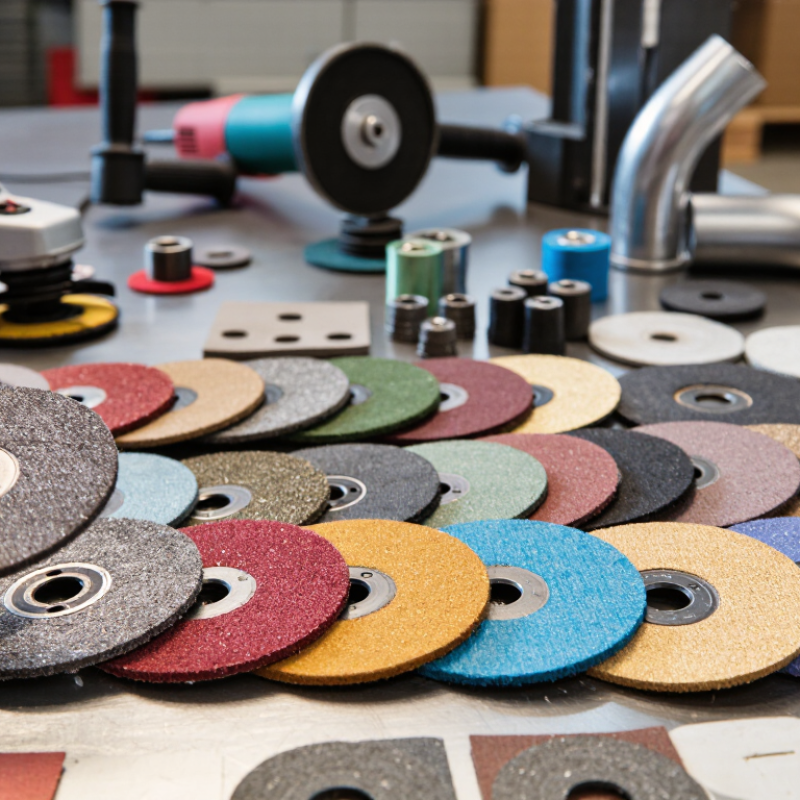
Fiber Disc Basics: FEPA P-Grades, Grain Types, and 115–180 mm Sizes
Fiber discs are selected by abrasive grain, FEPA P-grade, and diameter. These choices affect cutting speed, finish, and fit. FEPA P-grades describe grit size: lower numbers, such as P36, are coarser than P80. Coarse grades remove welds and heavy material quickly, while finer grades leave a smoother surface. The result also depends on pressure, workpiece material, and disc condition.
Aluminum oxide is a versatile option for general steel work. Zirconia alumina can suit heavier grinding, while ceramic grains are often chosen for demanding applications. Silicon carbide is useful on materials such as stone and some non-ferrous metals. Grain type is only part of the decision. A P60 disc in one grain may behave differently from another, so test a small area before committing to a large job.
Common diameters include 115, 125, and 180 mm. Match the disc to the grinder’s backing pad and rated capacity; a close-looking size is not enough. Check the maximum speed rating, too. That matters. In practice, operators sometimes choose a coarse grade to save time, then spend longer correcting scratches. I would not assume one grade works for every stage. Keep the workpiece steady, use suitable eye and face protection, and replace discs that are damaged or worn unevenly.
Common Fiber Disc Sizes: Surface Area Comparison
Common nominal fiber disc diameters range from 115 mm to 180 mm. Face areas shown are calculated from each diameter using the area of a circle (π × diameter² ÷ 4); they are geometric comparisons, not product availability or performance ratings.
Key Specifications: 22.23 mm Bore, Maximum RPM, and ISO 6344 Grit Marking
For global buyers, a 22.23 mm bore is a practical fit check for many common angle grinders. Confirm the spindle size and disc design before ordering; a matching diameter alone does not guarantee compatibility. Check that the disc’s backing and mounting arrangement suit the tool. Small mismatches can cause vibration or poor contact. Easy to overlook. Compare the product drawing and packaging, not just a marketplace listing. If dimensions are unclear, request a written specification from the supplier.
Maximum RPM is a safety limit, not a performance target. The disc rating must meet or exceed the grinder’s no-load speed, and the tool must never run faster than the disc allows. Read the marked value on each disc; do not assume every size in a product range shares one rating. ISO 6344 grit marking helps buyers compare abrasive grain size, such as coarser grades for stock removal and finer grades for finishing. Yet grit alone cannot predict cutting speed or service life. Bond, backing, pressure, and workpiece material matter too. I would treat a grit chart as a starting point, then test a small batch under controlled conditions.
Top 10 Fiber Disc Manufacturers for Global Buyers - Key Specifications: 22.23 mm Bore, Maximum RPM, and ISO 6344 Grit Marking
Manufacturer-neutral buyer reference. The speed figures below are approximate calculations at a reference peripheral speed of 80 m/s, not ratings for a specific product. Always follow the maximum RPM marked on the disc and the manufacturer’s instructions.
| No. | Specification to Compare | Reference Detail | Buyer Check |
| 1 | Disc bore | 22.23 mm (7/8 in) is a common bore size for angle-grinder fiber discs. | Match the bore to the tool spindle and the backing pad; confirm the product dimensions before ordering. |
| 2 | 115 mm disc speed reference | Approximately 13,300 rpm at 80 m/s peripheral speed. | Use only as a calculated reference. The disc’s marked maximum RPM takes precedence. |
| 3 | 125 mm disc speed reference | Approximately 12,200 rpm at 80 m/s peripheral speed. | Confirm that the grinder’s no-load speed does not exceed the disc’s marked maximum RPM. |
| 4 | 180 mm disc speed reference | Approximately 8,500 rpm at 80 m/s peripheral speed. | Check the disc diameter, tool rating, backing pad, and product marking as a set. |
| 5 | Maximum RPM marking | The allowable speed is product-specific; it depends on the disc design and size. | Require a legible maximum RPM or maximum operating speed on the product or packaging. |
| 6 | Grit marking system | ISO 6344 covers grading of coated abrasive grain; FEPA “P” designations are commonly used for coated abrasives. | Look for a clear grit designation, such as P36, P60, or P120, and confirm the system used. |
| 7 | Coarse-grit example | P36 is a coarse-grade designation commonly selected for heavier stock removal. | Check the recommended application and finish expectations for the workpiece. |
| 8 | Fine-grit example | P120 is a finer grade than P36 and is generally used where a finer surface finish is needed. | Confirm the grit range available and test the finish on the intended material. |
| 9 | Disc construction | Fiber discs commonly use abrasive grain on a vulcanized-fiber backing. | Ask for the abrasive type, backing details, and intended materials and applications. |
| 10 | Backing pad compatibility | Fiber discs are typically used with a compatible backing pad on an angle grinder. | Verify pad diameter, mounting fit, speed rating, and compatibility with the disc instructions. |
Top 10 Fiber Disc Manufacturers: Product Range, Backings, and Global Reach
Global buyers comparing fiber disc manufacturers should look beyond grit size. A useful range covers coarse stock removal, intermediate blending, and fine finishing, with clear options for abrasive grain, disc diameter, and hole pattern. Aluminum oxide suits many general-purpose tasks; zirconia and ceramic grains can offer stronger performance on demanding metal applications. Compatibility matters. A disc that does not seat securely or match the backing pad can wear unevenly and leave visible scratches.
Backing is just as important. Vulcanized fiber supports firm grinding, but thickness and stiffness affect control, heat, and edge durability. Ask suppliers for technical data sheets, recommended operating speeds, and consistent batch specifications. Small differences show up fast. A broad catalog is not proof of quality, though; test discs on your actual material and machine before setting purchase volumes.
Global reach affects lead times, documentation, and supply continuity. Grand View Research estimated the global abrasives market at about US$46.5 billion in 2022 and projected a 4.7% compound annual growth rate from 2023 to 2030. That figure covers abrasives broadly, not fiber discs alone, but signals a competitive, expanding sector. Buyers should compare regional stock, export packaging, and technical support alongside product range. I would still treat delivery promises cautiously: availability can vary by grit and backing, even within one catalog.
How to Compare Performance: Cut Rate, Service Life, and Cost per Part
A fiber disc should be judged by how it performs on the buyer’s actual material, not by its label price. Compare cut rate using the same grinder, workpiece, grit, and operating pressure. For example, time how long each disc takes to remove a marked section of steel, then check the finish for deep scratches or uneven edges. Keep the test consistent. A small change in pressure can distort the result.
Service life matters just as much. Record how many parts a disc completes before cutting slows or the finish becomes unacceptable. Then calculate cost per part by dividing disc cost by the number of acceptable parts produced. Include labor and changeover time when those costs are significant. A cheaper disc may need replacing more often; a longer-lasting one may cut slowly. The best result is not always obvious. Even a tidy spreadsheet can miss operator fatigue or differences between workpieces, so repeat the trial before making a large purchase.
Dust-Control Standards: OSHA’s 50 µg/m³ Silica PEL as an 8-Hour TWA
For global buyers comparing fiber disc manufacturers, dust control deserves the same attention as cut rate and disc life. In the United States, OSHA’s respirable crystalline silica permissible exposure limit is 50 micrograms per cubic meter, averaged over an eight-hour workday. This limit concerns respirable crystalline silica, not all airborne dust. The distinction matters.
A fiber disc does not automatically create silica exposure. Risk depends on the workpiece, coatings, abrasive materials, and grinding conditions. Grinding concrete or silica-containing coatings can produce fine particles that remain suspended after visible dust settles. A clean-looking bench is not proof of safe air. Buyers should ask whether discs suit shrouded tools and local exhaust systems, and request clear product and safety documentation.
Exposure control starts with the task, not the catalog. Use a compatible extraction hood, inspect hoses and filters, and avoid dry sweeping or compressed air where silica dust may be present. These steps reduce dust, but they do not establish compliance by themselves. Employers may need exposure assessments and controls under applicable requirements. OSHA rules apply in the United States; other markets have their own limits and procedures. Even experienced shops can overlook short grinding jobs, so review the actual material and work pattern rather than relying on assumptions.


