What Are the Top Cluster Gears for Global Buyers?
Cluster Gears remain essential in manual transmissions, industrial gearboxes, and compact powertrain systems. They combine multiple gear ratios on one shaft, helping equipment deliver controlled torque within limited space. For global buyers, the “top” option is not always the cheapest one. It must match load, speed, duty cycle, material, and maintenance conditions.
Recent industry data shows why careful selection matters. The International Energy Agency’s Global EV Outlook 2024 reported that electric car sales exceeded 17 million in 2024, increasing pressure on suppliers to redesign traditional transmission components. However, industrial machinery still depends heavily on robust mechanical gearing. Grand View Research’s automotive gears market analysis identifies efficiency, lightweight design, and precision manufacturing as major market drivers. These trends place Cluster Gears between proven mechanical reliability and changing powertrain requirements.
This guide compares spur, helical, and specialized cluster gear designs for international purchasing teams. It considers torque capacity, noise control, heat treatment, dimensional accuracy, and expected service life. AGMA and ISO 6336 standards provide useful references for rating gear strength and fatigue performance. Yet standards alone cannot guarantee success. Supplier inspection records, material certificates, backlash measurements, and batch traceability still matter.
Small details matter. A poorly controlled shaft tolerance can create vibration, uneven tooth contact, and premature wear. This comparison is not perfect, because operating data varies between industries and regions. Buyers should validate every recommendation against real duty cycles, local compliance needs, and after-sales support. Reliable sourcing begins with evidence, not attractive specifications.
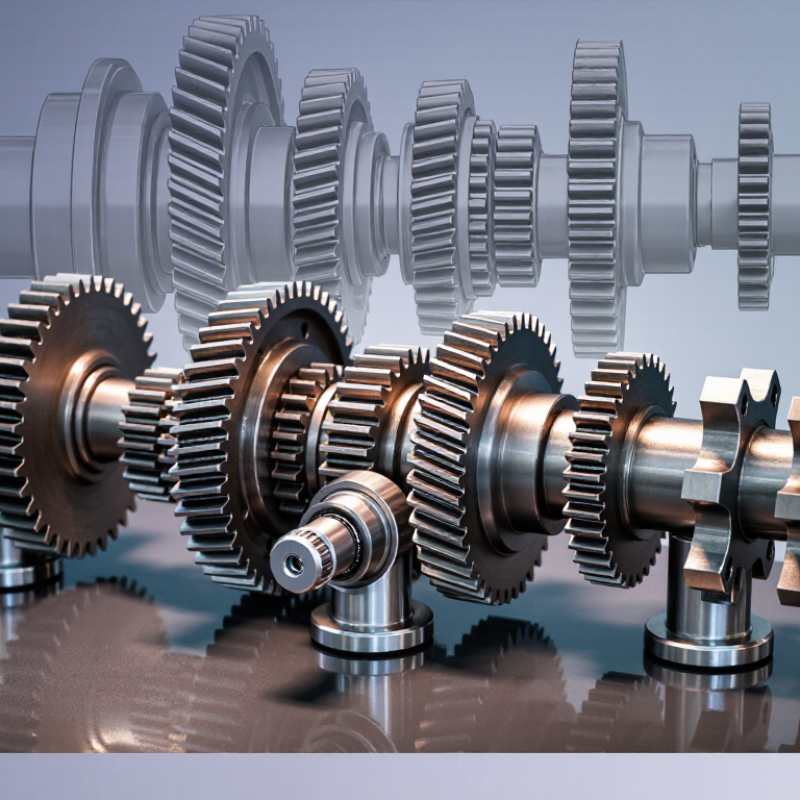
What Are Cluster Gears and How Do They Work?
A cluster gear is a group of gears fixed together on one shaft, usually called a layshaft. It transfers torque from the input shaft to selected gears on the output shaft. When the driver selects a ratio, a synchronizer locks the required gear to the output shaft. The other gears keep rotating freely. Simple, but not effortless.
Common choices include spur, helical, synchronized, and reverse cluster gears. Spur teeth are efficient and easier to manufacture, but they can produce noticeable noise. Helical teeth run more quietly and carry higher loads, although they create axial force and need stronger bearings. A 2023 ISO 6336 design framework remains widely used for calculating gear tooth load capacity and fatigue life. Buyers should also check hardness, tooth accuracy, backlash, lubrication, and shaft alignment. These details often decide whether a gearbox survives real work.
Market direction matters. The International Energy Agency reported nearly 14 million electric car sales in 2023, showing that traditional manual transmission demand is changing. However, industrial reducers, agricultural machinery, and replacement gearboxes still require durable cluster assemblies. A practical specification should state torque, speed, duty cycle, temperature, and expected service hours. “High strength” alone means very little. In my view, buyers sometimes overvalue material grade and undercheck heat treatment records. That is an imperfect approach. Supplier inspection reports, dimensional samples, and traceable material certificates provide stronger evidence than attractive catalog language.
What Are the Top Cluster Gears for Global Buyers? - What Are Cluster Gears and How Do They Work?
Typical specifications and selection guidance for industrial cluster-gear assemblies | Cluster Gear Configuration | How It Works | Typical Ratio Range per Mesh | Typical Mechanical Efficiency | Common Materials and Treatments | Best-Fit Applications | Key Buying Considerations |
| Straight-Tooth Fixed Cluster | Several spur gears are machined or mounted on one shaft and rotate together. A selected gear pair transfers power to the next shaft. | 1:1 to 5:1 | 94%–98% | Case-hardening steel; carburized or carbonitrided teeth; through-hardened alloy steel for moderate loads. | Machine tools, compact reducers, agricultural equipment, and general industrial transmissions. | Check backlash, tooth alignment, shaft deflection, noise level, and the required axial retention method. |
| Sliding-Gear Cluster | A gear cluster slides along splines so different gear pairs can be engaged directly. Power is transmitted through the selected pair. | 1:1 to 4.5:1 | 93%–97% | Low-carbon alloy steel with case-hardened teeth; nitrided steel may be used where wear resistance is important. | Older manual transmissions, basic gearboxes, low-to-medium-speed machinery, and serviceable mechanical drives. | Evaluate shift force, spline wear, engagement clearance, lubrication, and whether shifting under load is permitted. |
| Constant-Mesh Cluster | Gear pairs remain continuously meshed while a coupling sleeve or dog clutch locks the selected gear to the shaft. | 1.2:1 to 4:1 | 95%–98% | Carburized alloy steel, precision-ground flanks, and hardened splines for repeated engagement. | Industrial gearboxes, power take-offs, vehicle transmissions, and equipment requiring reliable repeated selection. | Confirm dog-clutch geometry, engagement speed limits, synchronization requirements, and service-part availability. |
| Helical Cluster Gear | Helical gears use angled teeth that engage gradually, reducing impact and operating noise while generating axial thrust. | 1.5:1 to 6:1 | 96%–99% | Case-hardened alloy steel; ground or honed tooth flanks; thrust-capable bearings are normally required. | High-load industrial drives, conveyors, compressors, pumps, and applications where low noise is important. | Allow for axial thrust, verify helix direction, specify contact pattern, and select a lubricant suitable for sliding action. |
| Multi-Speed Transmission Cluster | Multiple gears on a common countershaft provide several selectable ratios, allowing one input speed to produce different output speeds. | Overall 2:1 to 12:1 | 90%–97% per engaged path | Carburized or nitrided alloy steel; ground gears for high speed; forged shafts for high torque. | Machine tools, mobile machinery, transport equipment, and variable-speed mechanical systems. | Compare ratio spacing, rated input torque, allowable speed, shift mechanism, thermal capacity, and replacement tolerances. |
| Precision Ground Cluster | A cluster with accurately ground tooth flanks and controlled runout maintains consistent contact and minimizes vibration. | 1:1 to 8:1 | 97%–99% | Hardened alloy steel, carburized or nitrided; precision grinding after heat treatment. | Servo mechanisms, high-speed spindles, robotics, test equipment, and low-noise precision drives. | Request tooth-quality grade, pitch and profile tolerances, runout data, balancing requirements, and inspection records. |
Technical note: Cluster gears are multiple gears mounted on, or manufactured as part of, a common shaft. The gear set changes speed and torque by engaging different gear pairs. The ranges above are typical engineering values, not universal limits; actual performance depends on tooth geometry, module, face width, material, heat treatment, lubrication, alignment, temperature, load cycle, and manufacturing accuracy.
Which Types of Cluster Gears Are Most Widely Used?
What Are the Top Cluster Gears for Global Buyers?
In manual transmissions, constant-mesh cluster gears remain widely used because they offer reliable power transfer. Their gears stay engaged, while synchronizers help match speed during shifting. This design suits commercial vehicles, agricultural equipment, and many industrial drives. Helical teeth are common because they run more quietly than spur teeth. However, they create axial loads, so bearings and housing strength require careful attention.
Synchronized cluster gear sets are another leading choice for global buyers. They support smoother shifting and reduce gear tooth impact. A typical assembly may include a steel countershaft, several fixed gears, and hardened contact surfaces. Heat treatment improves wear resistance under repeated loads. Some buyers still choose spur-tooth clusters for low-speed machinery, simple reducers, and applications where efficiency matters more than noise control.
Planetary cluster gears also serve compact power systems. Multiple planet gears share the load around a central sun gear. This arrangement can deliver high torque within a smaller housing. It appears in automatic transmissions, winches, robotics, and heavy equipment. Yet planetary designs are not automatically better. They demand accurate alignment, controlled clearance, and consistent lubrication. A small tolerance error can produce uneven load sharing. Buyers should verify torque ratings, gear material, backlash, operating temperature, and service conditions before selecting a cluster gear type. In practice, the cheapest option may create higher maintenance costs later.
What Materials and Specifications Define Quality Cluster Gears?
For global buyers, cluster gear quality starts with material selection, not a glossy surface. Carburized alloy steels, such as 18CrNiMo7-6 or 8620, provide a tough core and wear-resistant teeth. Nitrided steels can reduce distortion, but their hardened layer is usually shallower. That difference matters under repeated shock loads.
The World Steel Association reported 1.89 billion tonnes of crude steel production in 2023. This scale supports broad material availability, yet steel grade alone proves little. Buyers should request heat-treatment records, chemical analysis, core hardness, case depth, and retained-austenite results.
ISO 6336 calculations should verify bending strength, pitting resistance, and contact stress. AGMA rating methods offer another useful comparison, especially when suppliers quote different service factors.
Specifications must match the application. Module, pressure angle, helix angle, face width, backlash, tooth accuracy, bore tolerance, and runout all influence noise and service life. A practical target may include ISO 8 or better accuracy for demanding drives, though the correct grade depends on speed and load. Too much hardness can make teeth brittle. Too little case depth can cause early pitting. Buyers sometimes focus on tensile strength and overlook alignment. That is a costly gap. Request dimensional inspection data from actual production parts, not only sample drawings. Small deviations become serious across a long gear train.
How Should Global Buyers Evaluate Cluster Gear Suppliers?
Global buyers evaluating cluster gear suppliers should begin with application evidence, not attractive catalog images. Ask for drawings, tooth profiles, material certificates, and measured backlash data. A reliable supplier can explain how each gear handles torque, shock loads, heat, and repeated cycling. Request samples from the same production line used for volume orders. Small differences matter. A cluster gear may fit during inspection yet fail after thousands of cycles.
Review manufacturing controls in practical detail. Check gear hobbing or shaping accuracy, heat-treatment records, surface hardness, and final inspection methods. Digital reports are useful, but traceable measurements are stronger. Ask whether gauges are calibrated and how rejected parts are separated. Factory visits can reveal worn fixtures, poor storage, or inconsistent cleaning. These details often predict delivery quality better than polished presentations. Confirm production capacity, lead times, packaging methods, and export documentation before placing an order.
Compare quotations by total risk, not unit price alone. Clarify tolerances, warranty terms, replacement procedures, tooling ownership, and payment milestones. Ask for a pilot batch and test it under realistic load, speed, lubrication, and noise conditions. Independent testing adds confidence for demanding equipment. Communication quality is also evidence: answers should be specific, documented, and consistent across teams. Some buyers rely too heavily on certificates. That is a mistake, although certificates still matter. Leave room for uncertainty and record every assumption before signing a supply agreement.
What Are the Top Cluster Gears for Global Buyers?
Global buyers commonly prioritize cluster gear suppliers by engineering capability, quality assurance, material traceability, delivery reliability, customization, and lifecycle support. The benchmark below uses a 100-point procurement evaluation model.
A strong supplier should provide documented gear calculations, validated heat-treatment processes, dimensional inspection records, material certificates, production traceability, and reliable international logistics.
What Applications and Markets Use Cluster Gears Most?
Cluster gears serve markets where compact torque transfer, selectable speeds, and mechanical durability matter. Automotive manual transmissions remain a major application. Their layshaft cluster combines several fixed gears inside one compact assembly. Commercial vehicles, agricultural tractors, construction equipment, and utility machinery also use similar arrangements.
The International Energy Agency reported global electric car sales above 17 million in 2024. That shift may reduce demand for traditional passenger-car manual transmissions. However, industrial equipment still needs robust mechanical drives. The International Federation of Robotics recorded more than 500,000 industrial robot installations worldwide in 2023. Robotic arms, automated conveyors, and machine tools often require precise gear reduction. Cluster-style gear trains can support these systems when serviceability and load capacity outweigh extreme miniaturization.
Industrial markets are not identical. Mining equipment faces dust, shock loads, and long operating cycles. Marine systems prioritize corrosion resistance and reliable torque transmission. Wind equipment requires careful alignment under fluctuating loads. The Global Wind Energy Council reported more than 117 gigawatts of new wind capacity installed in 2023, supporting continued demand for specialized transmission components. Still, broad market forecasts can mislead. Some reports combine cluster gears with complete gearbox categories.
Tips: Specify the application before comparing suppliers. Check torque, duty cycle, lubrication, backlash, tooth hardness, and operating temperature. Request test data for shock loads. A smaller gear cluster may save space, but it can sacrifice service life. That trade-off deserves closer review.


