Top 10 Rapid Tooling Manufacturers in China?
China’s manufacturing base makes it a practical place to source rapid tooling, but supplier capabilities vary widely. A polished website cannot confirm how consistently a factory holds tolerances or manages a rushed design change. The details matter.
Wohlers Report 2024 estimated global additive manufacturing revenues at $20.035 billion in 2023, an 11.1% increase over 2022. This figure covers additive manufacturing, not the rapid tooling market alone. Still, it signals growing use of technologies that can support prototype molds, low-volume parts, and design iterations. China’s National Bureau of Statistics reported that industrial value added rose 4.6% in 2023. That broader figure offers useful context, but it does not measure tooling demand or supplier quality.
This guide examines ten rapid tooling manufacturers in China through practical factors: process range, material options, stated lead times, quality systems, and communication. Look for details such as mold material, expected tool life, inspection records, and whether sample parts are available before production. These checks can reveal more than a low quotation.
No shortlist can replace a factory audit or a clearly scoped request for quotation. Supplier claims also deserve verification. Treat this overview as a starting point, not a guarantee; even capable manufacturers may be a poor fit for a particular part, budget, or schedule.
Rapid Tooling in China: Definition, Methods, and Applications
Rapid tooling in China means making molds and fixtures faster for short production runs. It bridges prototypes and repeatable manufacturing without requiring a full production tool. Common methods include aluminum or soft-steel molds, silicone casting, and additively manufactured inserts. A machined aluminum mold, for example, can produce plastic parts for fit checks or limited market trials. Tool choice depends on material, geometry, expected volume, and tolerance needs. It is not a magic shortcut. A fast tool can still need careful design reviews and test shots.
Applications range from consumer-product housings to automotive interior components and medical-device prototypes. Teams can examine real parts, check assembly gaps, and adjust details before committing to longer-run tooling. Shorter lead times may also help product developers respond to design changes. But speed alone is a poor measure of success. Surface finish, dimensional consistency, and mold life should be discussed before work begins. One often-overlooked weakness is unclear communication: a small mismatch in drawings or material assumptions can cause expensive rework. Buyers should request sample parts, inspection records, and a clear account of what the tooling is designed to achieve.
Rapid Tooling in China: Indicative Lead-Time Ranges
Typical planning estimates by tooling method, shown in calendar days. These are illustrative ranges, not China-specific market averages; actual lead times depend on part complexity, material, finishing, and validation requirements.
How to read this: Rapid tooling commonly supports prototypes, design validation, and low-volume or bridge production. 3D-printed inserts can be quick for limited runs, while aluminum and steel tooling generally take longer but can support more cycles and demanding production needs.
How China’s Rapid Tooling Industry Is Organized
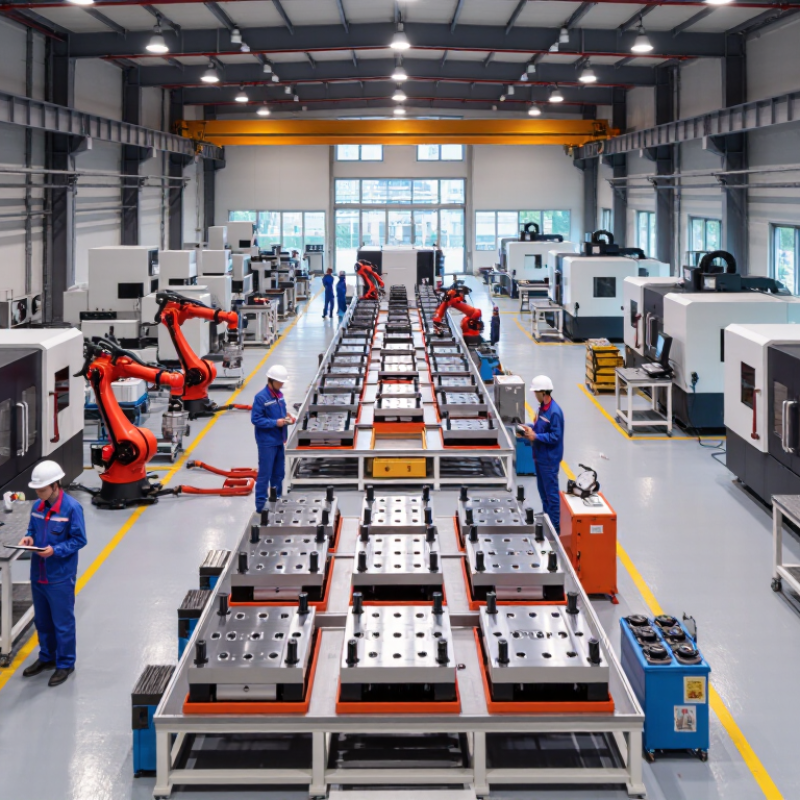
China’s rapid-tooling industry is organized as a network of specialized suppliers, not one uniform factory sector. Manufacturing clusters in the Pearl River Delta and Yangtze River Delta bring tooling shops close to machining, molding, finishing, and inspection services. These firms may coordinate schedules and technical files. A tooling supplier can turn CAD data into a mold or fixture, then check fit, draft, and access before machining begins. Some providers focus on machining; others also manage molding and sample delivery. This division can reduce handoffs, but it depends on clear communication. A small change to a rib or gate can affect filling, cooling, or part ejection.
Tips: Ask which operations happen in-house and which go to partners. Request a design-for-manufacturing review, a sample inspection report, and a timeline that includes revisions.
The network offers flexibility, but its boundaries are not always tidy. One supplier may coordinate several workshops, while another handles most steps under one roof. Buyers should confirm who owns each decision, from material selection to final dimensional checks. A 3D-printed or machined prototype can reveal fit issues early, though it may not behave like a molded part. Keep drawings, tolerances, and change approvals aligned. Even experienced teams can miss details when files or expectations differ.
Criteria for Evaluating Rapid Tooling Manufacturers
When comparing rapid tooling manufacturers in China, assess process control before headline price. Ask how the supplier handles draft angles, wall thickness, gate location, and cooling channels. Request a recent first-article inspection report, with dimensions tied to your drawing and tolerances. Check whether the shop can explain deviations, not just promise a fast correction. Useful evidence includes machine and material records, documented inspection methods, and a clear revision-control process. A polished sample is helpful, but it proves little about repeatability.
Lead time should include design review, tooling, sampling, and any rework—not just machining days. Ask for dated milestones and clarify who approves each sample. The Wohlers Report 2024 estimated that global additive-manufacturing revenues reached $20.035 billion in 2023, an 11.1% annual increase. This measures a broader production sector, not mold-tooling quality; still, it signals why suppliers may combine additive and conventional methods. Confirm which method suits your part and expected run size. Check the stated tool life against material and cycle conditions. A low quote can hide assumptions about finish, inspection, or revisions. I would not treat a certificate alone as proof; compare it with actual inspection records and a small trial run.
Profiles of 10 Rapid Tooling Manufacturers in China
These ten profiles represent common rapid-tooling capabilities across China’s manufacturing regions, not audited company rankings. One Shenzhen supplier profile focuses on CNC-machined aluminum molds, with short lead times and clear machining plans. A Dongguan workshop may specialize in silicone tooling and small-batch plastic parts. A Suzhou maker often emphasizes precision mold components, where tight tolerances matter. Near Ningbo, an injection-tooling supplier may support export-oriented projects and provide mold trials. An engineering-led Shanghai profile typically offers design-for-manufacturing reviews before cutting steel. Details vary by shop.
A Hangzhou supplier profile may suit low-volume bridge production, while an Xiamen workshop could focus on composite or prototype tooling. A Chongqing maker may serve automotive prototype programs, where fit checks and repeatability are important. Wuxi suppliers can be assessed for die-casting tooling and dimensional inspection. A Guangzhou profile may combine sheet-metal fixtures with plastic rapid tooling. Ask each candidate for recent sample reports, material certificates, and a realistic timeline. Request photos of tool surfaces and trial parts. Not every supplier excels at every process; I would verify claims with a small paid trial before committing to production.
Comparing Suppliers by Process, Quality, Lead Time, and Cost
A useful comparison of China’s rapid tooling manufacturers starts with process fit, not headline price. CNC machining suits tight tolerances and durable metal parts; aluminum tooling can support short injection-molding runs, while 3D printing helps test complex shapes quickly. Wohlers Report 2024 estimated the global additive manufacturing industry reached $21.8 billion in 2023, up 11.1% year over year. That growth shows wider adoption, but it does not prove any supplier’s accuracy or delivery record. Ask for process-specific sample parts, inspection records, and stated tolerances. Check whether measurements cover critical features, not just the easiest surfaces.
Lead-time quotes need equal scrutiny. Request a schedule broken into design review, tooling, first-article inspection, and shipping. A quoted seven-day build may exclude revisions or freight. Small detail, big difference. For quality systems, ISO’s 2022 survey recorded more than 1.2 million valid ISO 9001 certificates worldwide; certification alone, however, cannot verify a particular factory’s process control. Compare like-for-like quotes using the same material, finish, quantity, tolerance, and inspection scope. Ask about mold-life assumptions and the cost of changes after approval. A cheaper quote can be sensible, but only when its exclusions are clear. I would still hesitate to rank suppliers from public claims alone; independent sample inspection takes time, and that part is often overlooked.