Top 10 Types of Rapid 3D Printing for Global Buyers?
Rapid 3D printing is reshaping how global buyers develop, test, and manufacture physical products. It can turn a digital design into a usable part within hours, rather than weeks. A polymer housing may leave an SLA machine with a smooth surface by morning. A nylon bracket may emerge from an SLS bed ready for functional testing.
The market is expanding, but technology selection remains difficult. The Wohlers Report 2024 valued the global additive manufacturing industry at approximately $20.0 billion in 2023, including systems, materials, software, and services. Its findings show continued growth beyond traditional prototyping. SmarTech Analysis also identifies production applications as a major driver, especially in aerospace, medical, automotive, and industrial manufacturing. These figures require careful reading. Market boundaries differ between reports.
As Avi Reichental, a widely recognized 3D-printing executive and industry expert, said, “3D printing is the next industrial revolution.” The statement is ambitious, perhaps too broad for every buyer. Still, it reflects the technology’s expanding role in distributed production. This guide examines ten major types of rapid 3D printing, including FDM, SLA, SLS, SLM, DLP, PolyJet, and binder jetting. Each method has different limits. Speed can reduce detail, material choice, or surface quality. The best process depends on volume, tolerance, geometry, certification needs, and total delivered cost. No single machine wins everywhere. That is the honest complication. Global buyers should compare printed samples, production data, maintenance support, and supplier experience before committing.
Rapid 3D Printing: Definition, Features, and Global Buyer Needs
Top 10 Types of Rapid 3D Printing for Global Buyers?
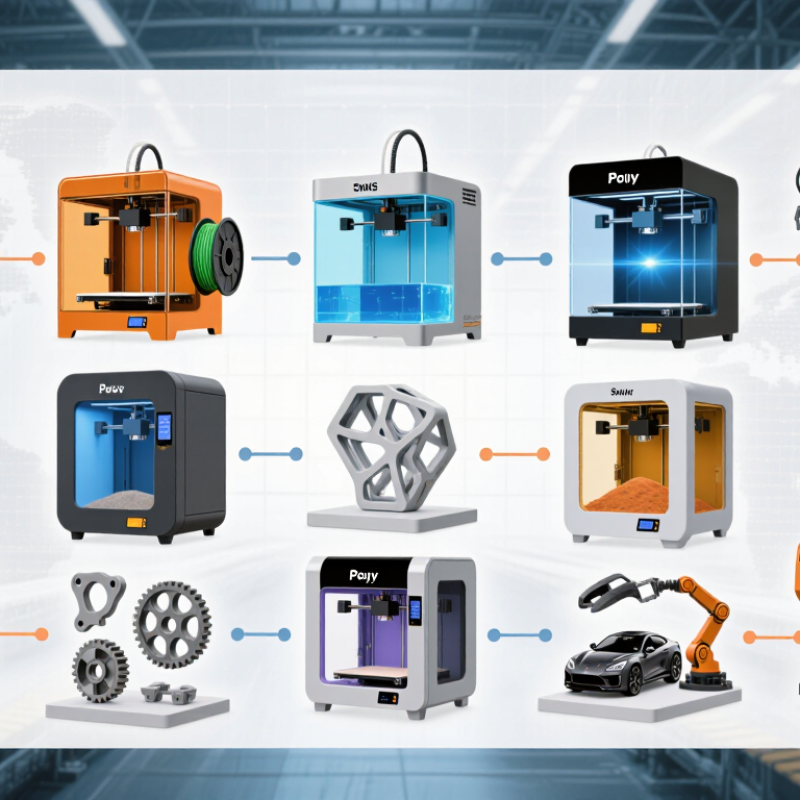
Rapid 3D printing creates physical parts directly from digital designs. It reduces tooling time and supports fast design testing. The ten common methods include FDM, SLA, DLP, LCD, SLS, MJF, PolyJet, metal laser powder bed fusion, binder jetting, and directed energy deposition. Each process has different strengths. FDM suits durable prototypes and simple fixtures. SLA and DLP produce smooth, detailed models. SLS and MJF create strong polymer parts without support structures. Metal processes serve demanding engineering applications.
Speed depends on more than printer motion. Part size, layer height, material, nesting, cooling, and post-processing all affect delivery. A small resin model may finish quickly, yet washing and curing still require time. A metal component may need heat treatment, machining, or inspection. Global buyers should request material data, dimensional tolerances, surface-finish samples, and production photos. Clear communication prevents costly misunderstandings across time zones.
Quality evidence matters. Ask for inspection records, process controls, and relevant safety or material documentation. Local regulations may also affect shipping and product use. In practical sourcing, a fast quotation is not always a fast solution. I have seen attractive lead times change after support removal and finishing were included. That weakness deserves honest discussion. Buyers should compare total lead time, not only printing hours. Sample approval remains useful, even for urgent orders.
The Top Ten Rapid 3D Printing Technologies Explained
The Top Ten Rapid 3D Printing Technologies Explained
Rapid 3D printing includes ten distinct processes, each suited to different production needs. Fused deposition modeling builds parts from heated thermoplastic filament. It is affordable, practical, and useful for fixtures, prototypes, and low-volume components. Stereolithography cures liquid resin with a laser, producing smooth surfaces and fine details. Digital light processing and masked stereolithography expose entire layers, often improving production speed. Selective laser sintering fuses powdered polymer without support structures. It works well for complex shapes and functional prototypes. Multi Jet Fusion applies agents across powder layers, creating consistent nylon parts with efficient batch production. Speed matters here.
Metal applications require stricter control. Selective laser melting fully fuses metal powder, supporting strong aerospace, medical, and industrial components. Electron beam melting uses an electron beam in a controlled vacuum, making it suitable for certain reactive metals. Binder jetting deposits a liquid binder onto powder, then relies on curing and sintering. It can produce many parts quickly, although shrinkage requires careful compensation. Material jetting places tiny droplets of photopolymer or wax, enabling precise models and multiple materials. Post-processing remains important.
In supplier evaluations, I check dimensional data, surface requirements, material certificates, and repeatability before choosing a process. A fast build can still create delays through washing, support removal, machining, or heat treatment. Cost estimates also change with nesting, powder recovery, labor, and inspection. Some resin parts look excellent but may age poorly under heat or sunlight. Metal printing may achieve impressive strength, yet internal porosity and residual stress demand testing. The right choice is rarely the fastest machine. It is the process that matches the part’s real service conditions. Mistakes happen. Good engineering leaves room to question early assumptions.
Top 10 Types of Rapid 3D Printing Technologies
Representative typical layer thicknesses used in rapid 3D printing. Lower values generally indicate finer vertical detail, while actual production speed also depends on part geometry, material, machine settings, and post-processing.
Typical values shown are industry-standard process ranges: PolyJet approximately 0.016 mm, DMLS/SLM approximately 0.03 mm, SLA/DLP/MSLA approximately 0.05 mm, EBM approximately 0.05 mm, MJF approximately 0.08 mm, SLS and binder jetting approximately 0.10 mm, and FFF approximately 0.20 mm. Actual specifications vary by equipment and material.
Applications, Industry Fit, and Production Volume Considerations
Top 10 Types of Rapid 3D Printing for Global Buyers
Global buyers should compare rapid 3D printing by application, material, accuracy, and production volume. SLA produces smooth prototypes, dental patterns, and detailed display parts. FDM suits affordable jigs, housings, replacement components, and early functional testing. SLS handles durable polymer parts with complex shapes and minimal support structures. DLP works well for small, highly detailed components, although build size can be limited.
Material jetting creates realistic visual models with multiple colors or textures. Binder jetting supports larger batches and porous metal or sand-based components. Selective laser melting produces strong metal parts for aerospace, medical, and industrial applications.
Electron beam melting fits certain dense metal geometries but requires specialized process control. Directed energy deposition repairs or adds material to large metal components. Laminated object manufacturing remains useful for fast visual models and low-cost concept studies.
Industry fit changes the purchasing decision.
Consumer product teams may prefer SLA, DLP, or material jetting for design reviews. Automotive suppliers often choose FDM, SLS, or metal powder-bed methods for fixtures and functional testing. Low volumes favor flexible machines with simple setup. Medium volumes may benefit from batch nesting and automated post-processing. Higher volumes require repeatability, labor planning, inspection, and predictable material supply.
No method wins every time.
A cheaper part can become expensive after finishing, failed builds, or manual inspection. Buyers should request sample parts, tolerance reports, surface-finish data, and realistic lead times. Even experienced teams sometimes overestimate throughput. Production plans need room for that mistake.
How Global Buyers Compare Suppliers, Costs, and Quality Standards
Global buyers compare rapid 3D printing suppliers by process fit, not impressive sample parts. The main options include SLA, SLS, FDM, binder jetting, material jetting, and metal powder bed fusion. Each serves different needs. SLA can deliver smooth prototypes, while SLS supports complex nylon parts without support structures. Metal powder bed fusion suits demanding components, but inspection and finishing can increase costs sharply.
The Wohlers Report 2024 valued the global additive manufacturing industry at approximately 20.04 billion US dollars in 2023. It also reported 13.5% year-on-year growth. That expansion gives buyers more supplier choices, but price comparisons remain imperfect. A low quotation may exclude tooling, support removal, heat treatment, surface finishing, packaging, or dimensional inspection. Ask for a cost breakdown. Always.
Quality comparisons should use measurable evidence. ISO/ASTM 52900 provides common additive manufacturing terminology, reducing confusion between suppliers. Buyers should also request material certificates, machine calibration records, process parameters, and inspection methods. For repeat production, evaluate dimensional capability across several builds, not one successful sample. Reports from the National Institute of Standards and Technology repeatedly highlight process monitoring and traceability as important quality controls. Still, supplier documents can be incomplete or outdated. I have seen attractive prototypes hide inconsistent tolerances. A practical review should include a pilot batch, agreed acceptance limits, and photographs of critical surfaces. Delivery reliability deserves equal attention. A technically excellent supplier can still fail when production schedules change.