2026 How to Choose the Best Welding Positioner?
Choosing the right Welding Positioners in 2026 starts with the part, not the catalogue. A small rotary table may suit a compact fabrication shop; a long vessel needs stable support, adequate rotation, and carefully matched load capacity. Picture a weld seam held at a comfortable angle instead of forcing the operator to reach beneath a hot assembly. That simple change can improve access and consistency, but only when the fixture, workpiece, and operating method are properly matched.
The American Welding Society’s workforce projections have highlighted the need for hundreds of thousands of welding professionals in the United States by 2028. That figure is not a positioner-market statistic, and it should not be treated as one. It does, however, underline why efficient, repeatable welding setups matter to busy shops. Welding texts by Larry Jeffus offer useful grounding in welding processes and practical shop methods; positioner selection still requires checking the manufacturer’s load charts, center-of-gravity limits, rotation range, and duty cycle. A useful shop-floor rule for this guide is: “Bring the joint into a controllable position; never assume the machine makes every weld easier.” This is an editorial principle, not a verified quotation from Jeffus. Some details are easy to overlook. A workpiece may fit the rated weight yet exceed the positioner’s allowable offset load. Before choosing equipment, compare the real assembly dimensions with the published specifications, then consider controls, speed, and operator access. The best choice is the one that suits the actual work—not the largest model on the showroom floor.
Map Weld Access to AWS 1G–4G Positions and Part Geometry
Choose a welding positioner by tracing the weld path, not by looking only at the part’s weight. AWS 1G, 2G, 3G, and 4G describe groove-weld test positions: flat, horizontal, vertical, and overhead. They help clarify access, but they do not describe every production joint. A rotating positioner can bring a circumferential seam into a flatter working angle. However, clamps, openings, and nearby walls may still block the torch. A drawing can look clear, yet the torch may foul a fixture.
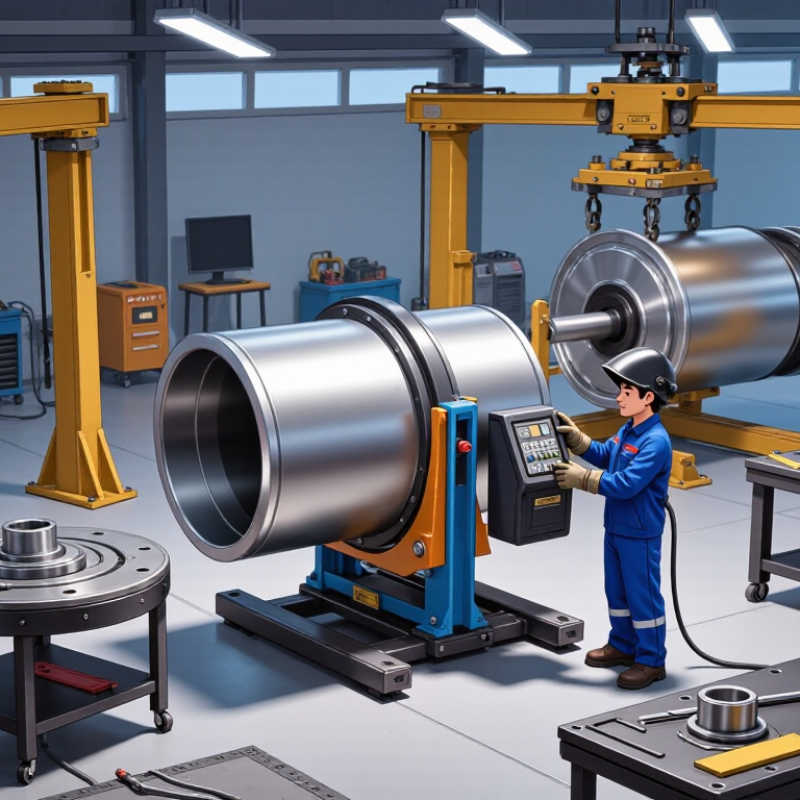
Match the machine’s movement to the part. A horizontal pipe axis that rotates can expose a circumferential seam steadily; a bulky frame may need tilt and rotation to reach several sides. Check where the torch, cable, and operator must travel, and leave room for tack welds and loading. If the procedure requires a fixed 3G or 4G position, rotating the work may not meet that requirement. This detail is easy to overlook.
Tips: Dry-run the full weld path with a mock torch. Check clearances at both ends of travel. Note any awkward reach; a positioner does not fix every access problem.
Calculate Total Payload and Eccentric Moment: M = W × e
A positioner’s payload is not just the weldment. Add the fixture, clamps, and any tooling that rotates with it. Then locate the combined center of gravity and measure its offset from the rotation axis. Small parts count. If the assembly and tooling total 500 kg, and the center of gravity sits 0.35 m off-axis, the eccentric moment is about 1,716 N·m: 500 × 9.81 × 0.35. Measure, do not guess.
Check the unit basis on the equipment rating. Some ratings use kg·m; others use N·m, and those figures are not interchangeable without conversion. The U.S. National Institute for Occupational Safety and Health’s Applications Manual for the Revised Lifting Equation uses 23 kg as a load constant under ideal manual-lifting conditions. That is not a positioner limit, but it reinforces why loading plans should avoid relying on workers to steady heavy, awkward parts by hand. A common planning miss is counting the workpiece but forgetting the fixture’s mass or offset. Recalculate when either changes.
The calculation also assumes a known, stable center of gravity. Weldments can be uneven, and temporary clamps may shift balance. Confirm the setup with the actual assembled load, then compare both payload and moment with the positioner’s rated limits. Leave room for uncertainty; a neat spreadsheet can still be wrong.
Compare Tilt, Rotation Speed, and Torque Ratings at Full Load
2026 How to Choose the Best Welding Positioner?
Compare Tilt, Rotation Speed, and Torque Ratings at Full Load
Tilt range matters only if the workpiece can reach the required angle safely. Check the fixture, clamps, and cables at the steepest position. A broad tilt range is useful, but it does not guarantee stable handling. Confirm the rated load includes the workpiece and its fixture, not just the part.
Rotation speed should suit the weld. Thin sections and short circumferential welds often need slow, steady motion; faster rotation can help with larger, consistent runs. Check whether the speed range remains usable under full load. A positioner may turn smoothly when empty and hesitate once a heavy, off-center assembly is mounted. That matters.
Torque ratings deserve close attention. Torque must overcome the load’s imbalance, especially when its center of gravity sits away from the rotation axis. Ask for ratings at the intended load and mounting offset, then compare them with your actual setup. A trial with a secured test piece can reveal vibration, drift, or awkward controls that a specification sheet misses. I would still question any rating without clear test conditions. A number alone is not enough.
2026 How to Choose the Best Welding Positioner? — Compare Tilt, Rotation Speed, and Torque Ratings at Full Load
Use this generic engineering guide to compare positioner size, tilt range, rotation speed, and estimated tilt torque. Select a unit based on the workpiece’s total weight, center of gravity, welding process, and required positioning accuracy.
| Example Load Class | Rated Workpiece Load | Example Tilt Range | Typical Table Rotation Speed | Assumed Maximum CG Offset from Tilt Axis | Estimated Minimum Tilt Torque at Full Load | Typical Applications | Selection Notes |
| Light duty | 250 kg | 0°–135° | 0.1–1.0 rpm | 150 mm | At least 0.55 kN·m | Small brackets, flanges, and short pipe sections | Suitable when the workpiece is compact and its center of gravity stays close to the tilt axis. |
| Medium duty | 500 kg | 0°–135° | 0.05–0.8 rpm | 200 mm | At least 1.47 kN·m | Frames, tanks, and medium-sized fabricated assemblies | Check whether the stated capacity includes fixtures, clamps, and tooling in addition to the workpiece. |
| Heavy duty | 1,000 kg | 0°–135° | 0.03–0.6 rpm | 250 mm | At least 3.68 kN·m | Large structural weldments, vessel components, and heavy pipe assemblies | Confirm that the load is balanced and that the positioner can safely handle the required fixture arrangement. |
| Extra heavy duty | 2,000 kg | 0°–135° | 0.02–0.4 rpm | 300 mm | At least 8.83 kN·m | Large vessels, bulky frames, and heavy fabricated structures | Request a load-and-CG review for offset, irregular, or dynamically repositioned workpieces. |
Torque basis: The estimated minimum tilt torque uses static gravity torque × 1.5: workpiece mass × 9.81 m/s² × assumed CG offset × 1.5. These are calculated example sizing targets, not specifications for particular machines. The calculation excludes fixture mass, acceleration, friction, shock loading, and other design factors. For final selection, verify the manufacturer’s rated tilt torque at the actual full-load center of gravity, along with rotation speed under load, duty cycle, tilt range, and safety requirements.
Match Controls and Duty Cycle to the Welding Process
2026 How to Choose the Best Welding Positioner?
Match Controls and Duty Cycle to the Welding Process
A welding positioner should suit the work, not just the part’s weight. For thin stainless steel or careful TIG work, choose smooth, low-speed rotation and fine speed adjustment. A foot pedal can help an operator make small corrections while keeping both hands near the torch. That matters. Jerky movement can spoil a weld.
For repetitive MIG welding, a positioner with straightforward speed controls and dependable rotation may save time between passes. If the job also requires tilting, check that the controls make rotation and tilt easy to manage independently. A hand pendant offers useful control from a short distance, but its cable can snag around a crowded fixture. These details are easy to overlook.
Duty cycle deserves equal attention. It describes how long equipment can operate within a specified period and under stated conditions; check the manufacturer’s rating and operating guidance. A machine that runs only occasional repairs may not need the same duty cycle as one rotating parts through a long production shift. Undersizing can lead to interruptions, while oversizing may add cost without practical benefit. Match capacity to the heaviest actual setup, including clamps and fixtures, and consider the work’s balance. I would still verify the setup with a representative part before committing.
Check Safeguards Against ISO 12100 and ISO 13849-1
When choosing a welding positioner, examine its safeguards alongside its load capacity and rotation range. ISO 12100 provides a framework for identifying hazards and reducing risk. Picture a heavy cylinder turning near an operator’s hands. Pinch points, dropped workpieces, and unexpected motion deserve attention.
Ask for the machine’s risk assessment and check whether it covers setup, loading, welding, and maintenance. Physical barriers can separate operators from moving parts. Interlocked guards should stop hazardous motion when opened. Emergency stops must be easy to reach, but they are not a substitute for guarding. Small details matter. Check labels, access points, and safe ways to secure a workpiece.
ISO 13849-1 addresses safety-related parts of control systems. Ask what required performance level applies to each safety function, and how the system was validated. The answer should connect to the risk assessment, not just a component list. Test the stop function and guard interlocks during acceptance. Keep a written record. Real workshops are messy, and I would not assume a tidy demonstration reflects every operating condition. Confirm that safeguards still work during foreseeable faults and routine servicing.


