Choosing dinosaur outdoor decorations is more than picking the largest model in a catalog. A convincing display should fit your yard, climate, budget, and intended audience. A towering Tyrannosaurus may impress visitors, but it can overwhelm a small garden or block a walkway. Measure the available space before shopping. Leave clear paths around gates, steps, and outdoor furniture.
Material quality matters outdoors. Fiberglass, resin, treated metal, and weather-resistant plastics perform differently under sunlight, rain, wind, and freezing temperatures. Look for UV-resistant coatings, sealed joints, stable bases, and clear care instructions. A professional supplier should provide dimensions, weight, assembly details, and recommended anchoring methods. Customer reviews can reveal practical problems, such as fading paint, weak hinges, or difficult installation.
Think about the story your decorations will create. A small herbivore near flowers feels playful, while a raptor beside rocks creates movement and drama. Natural colors may blend into a landscape better than bright, artificial shades. Lighting can help at night, but exposed cables require careful placement and weather protection. Never ignore stability.
There is no perfect decoration. Even a well-designed model may need seasonal cleaning or repainting. I once underestimated how quickly dust collected around textured scales. That mistake changed my maintenance plan. Consider storage, repairs, and neighborhood appearance before purchasing. When appearance, durability, safety, and proportion work together, Dinosaur Outdoor Decorations can make an outdoor space memorable without making it chaotic.
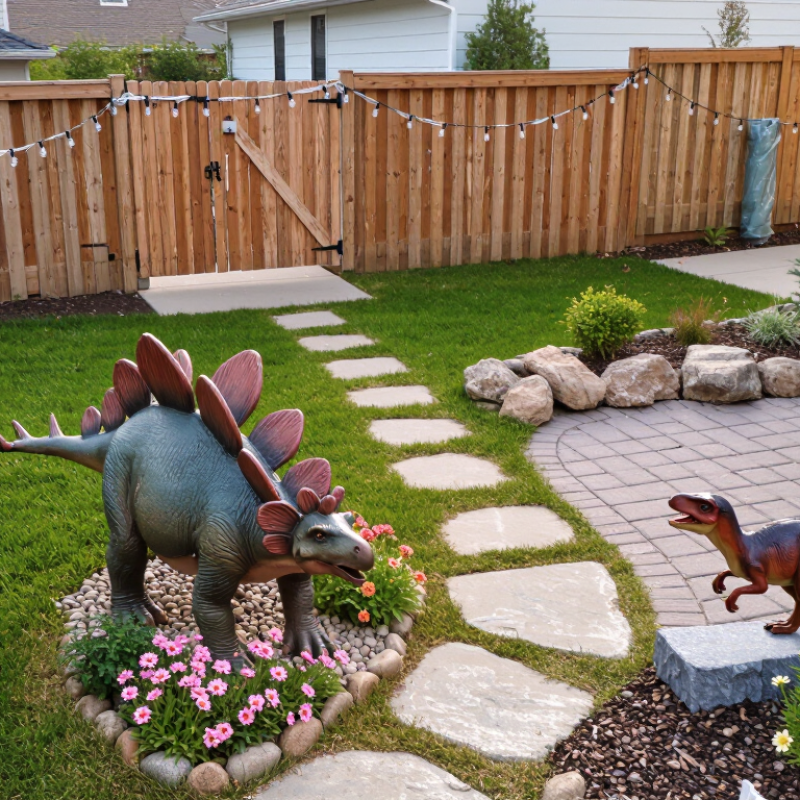
Choosing dinosaur outdoor decorations starts with purpose, not appearance. A school courtyard needs clear walking paths and durable, readable forms. A garden display can use smaller figures beside shrubs, stones, or a pond. Measure viewing distance and ground space before selecting a species. A striking dinosaur feels awkward when its tail blocks a walkway. Measure twice.
Scale should match the site and the visitor’s body. At 1:10 scale, a ten-meter dinosaur becomes about one meter long. It suits patios, narrow entrances, and compact educational scenes. At 1:5, a two-meter figure represents a ten-meter animal and feels more noticeable. A 1:1 decoration follows the animal’s estimated real dimensions. It needs generous clearance, stable ground, and space for visitors to step back. Check the full length, including the tail and open jaws. Those details often consume more space than expected.
Use proportion as a planning tool, not a promise of scientific certainty. Fossil evidence may leave height, posture, and skin texture open to interpretation. Ask an experienced fabricator for a dimension drawing before installation. It should show total length, highest point, base width, and anchor positions. Weather exposure matters too. Sun, rain, and freezing soil can weaken finishes or foundations. I would recheck the layout using temporary ground outlines. Paper measurements seemed accurate, yet the final pose looked crowded. Leave room for walking, clear sightlines, and routine maintenance. A smaller figure can communicate scale better than an oversized one in a cramped site.
For five to ten years outdoors, material choice matters more than dinosaur size. Fiberglass offers sharp scales, light weight, and easy installation. However, its surface can chalk under ultraviolet exposure. Small cracks may also appear around thin horns or joints. UV-resistant gelcoat and sealed drainage holes are essential.
Steel provides the strongest frame for large dinosaur figures. It handles wind and repeated public contact well. Yet damaged paint can expose metal to moisture and rust. The 2016 NACE IMPACT study estimated global corrosion costs at about 2.5 trillion dollars annually. That figure shows why coating inspection should not be ignored. Galvanized steel or a properly protected powder-coated structure can support long outdoor service, but coastal sites need closer maintenance.
HDPE is practical for wet parks and family areas. It resists impact, moisture, and many common cleaning chemicals. Its color can extend through the sheet, making scratches less obvious. Still, HDPE expands with temperature and may slowly deform under constant loads. It can look less sculptural than fiberglass. That trade-off deserves honest consideration.
Tips: Ask for UV testing based on ASTM G154 or ISO 4892-3. Check wall thickness, drainage, fasteners, and coating repair procedures. In windy regions, request anchoring calculations. Inspect every spring. Even durable materials fail when water remains trapped inside.
A dinosaur decoration is not only a visual feature. It becomes a wind-exposed structure. ASCE 7-22 defines design wind speeds as three-second gusts, measured at 33 feet above open terrain. The correct value depends on location, risk category, exposure, and site conditions. A municipal wind map may show 115 mph, while a nearby coastal zone may require 140 mph. Do not guess from yesterday’s weather.
For a practical screening calculation, use:
qz = 0.00256KzKztKdV² Suppose the local ASCE 7-22 ultimate speed is 120 mph. Using Kz = 0.85, Kzt = 1.0, and Kd = 0.85 produces about 27 psf before applying shape effects. A broad dinosaur tail or raised sail can increase force significantly. The International Building Code adopts ASCE 7 wind provisions, so local officials and qualified engineers should verify the final design.
Check the actual installation area. A 10-foot dinosaur beside a fence faces different turbulence than one in an open field. Measure its projected area, anchor spacing, base weight, and connection strength. FEMA guidance on nonstructural components repeatedly emphasizes secure anchorage and load paths.
I have seen attractive displays fail because the base was treated as decoration, not structure. That assumption was wrong. Recheck it after rain, soil softening, or repeated gusts. A conservative choice may look less dramatic, but it usually performs better.
When choosing dinosaur outdoor decorations, inspect weather protection through two different lenses: ASTM G154 and IP65.
ASTM G154 evaluates accelerated exposure to ultraviolet light, moisture, and temperature changes. Its fluorescent UV lamps can reveal fading, brittle plastic, cracked paint, or weakened seams before a decoration faces months of sunlight.
Ask for the test cycle, lamp type, exposure duration, and material samples. A vague “UV tested” claim is not enough.
ASTM G154 does not automatically certify every finished product for outdoor use.
IP65 measures enclosure protection. The first six means the enclosure is dust-tight. The five indicates resistance to water jets, not permanent immersion or powerful storm flooding.
Check whether cables, battery compartments, switches, and access panels maintain that protection after assembly. Small gaps around a tail joint can collect rainwater. They often matter more than the large body shell.
Field inspection still helps: look for drainage holes, sealed connectors, stable bases, and coatings without pinholes. These details are easy to miss.
Use both benchmarks carefully. ASTM G154 addresses long-term sunlight and moisture stress, while IP65 addresses dust and water entry at a defined test level.
Neither standard proves resistance to hail, freezing temperatures, coastal salt, or strong wind.
I would avoid overconfidence here. A decoration may pass laboratory testing yet age poorly beside a hot, reflective wall.
Compare test evidence with your actual climate, installation surface, and maintenance access.
How to Choose Dinosaur Outdoor Decorations?
Choose a dinosaur decoration that matches the site, not only the theme. Measure the display area before ordering. Leave clear walking space around tails, claws, and low branches. Consider surface type, decoration height, weight, and expected wind exposure. A lightweight model may need stronger anchoring than a heavy one.
Tips
Use corrosion-resistant ground anchors suited to soil or concrete. Secure each main support point, then test the decoration by applying steady hand pressure. It should not rock, scrape nearby surfaces, or create a trip hazard. Place soft barriers around sharp edges during installation. Follow the maker’s instructions and check local outdoor safety requirements. Do not improvise with weak rope or loose stones.
Inspection should happen after installation, heavy rain, strong wind, and freezing weather. Check bolts, welds, seams, cables, and anchor plates closely. Look for leaning, cracked coatings, water inside hollow sections, or fading that hides damage. A small movement matters. Record inspection dates and repairs with simple photos. Monthly checks are useful, but busy public areas may need weekly attention.
Create a maintenance cycle for cleaning, tightening, repainting, and replacing worn parts. Use mild soap and a soft brush; harsh chemicals can damage protective finishes. Remove pooled water before it freezes. A plan can still miss something. Review the routine after each season and adjust it when the site changes.
| Cookie | Duration | Description |
|---|---|---|
| cookielawinfo-checkbox-analytics | 11 months | This cookie is set by GDPR Cookie Consent plugin. The cookie is used to store the user consent for the cookies in the category "Analytics". |
| cookielawinfo-checkbox-functional | 11 months | The cookie is set by GDPR cookie consent to record the user consent for the cookies in the category "Functional". |
| cookielawinfo-checkbox-necessary | 11 months | This cookie is set by GDPR Cookie Consent plugin. The cookies is used to store the user consent for the cookies in the category "Necessary". |
| cookielawinfo-checkbox-others | 11 months | This cookie is set by GDPR Cookie Consent plugin. The cookie is used to store the user consent for the cookies in the category "Other. |
| cookielawinfo-checkbox-performance | 11 months | This cookie is set by GDPR Cookie Consent plugin. The cookie is used to store the user consent for the cookies in the category "Performance". |
| viewed_cookie_policy | 11 months | The cookie is set by the GDPR Cookie Consent plugin and is used to store whether or not user has consented to the use of cookies. It does not store any personal data. |