How to Choose Hair Dryers for Wholesale Buyers in 2026
Wholesale hair dryer buying in 2026 is not just a price exercise. It is a test of product consistency, supplier discipline, and market fit. Grand View Research estimated the global hair dryer market at USD 10.1 billion in 2023, with projected annual growth of 5.3% from 2024 to 2030. That growth creates opportunity. It also raises the cost of choosing poorly.
For buyers searching for the 2026 best hair dryer for global wholesale buyers, headline wattage is only one clue. Compare airflow, heat settings, motor life, noise, weight, and filter access. Ask for repeatable test results, not only a polished sample. Confirm voltage options, plug configurations, warranty terms, and available safety documentation for each destination market. A carton can look perfect and still hide inconsistent units.
Dyson hair-care engineering manager Dr. Tim Moore has highlighted intelligent heat control as a way to help limit extreme-heat exposure. That is a useful design principle, not a substitute for independent testing. Buyers should request performance data, inspect production samples, and clarify what happens when defects appear. A small batch can reveal more than a long catalogue. There is no perfect dryer for every channel; salon distributors, retailers, and online sellers may value different features. This guide turns those trade-offs into practical checkpoints for supplier evaluation and bulk purchasing.
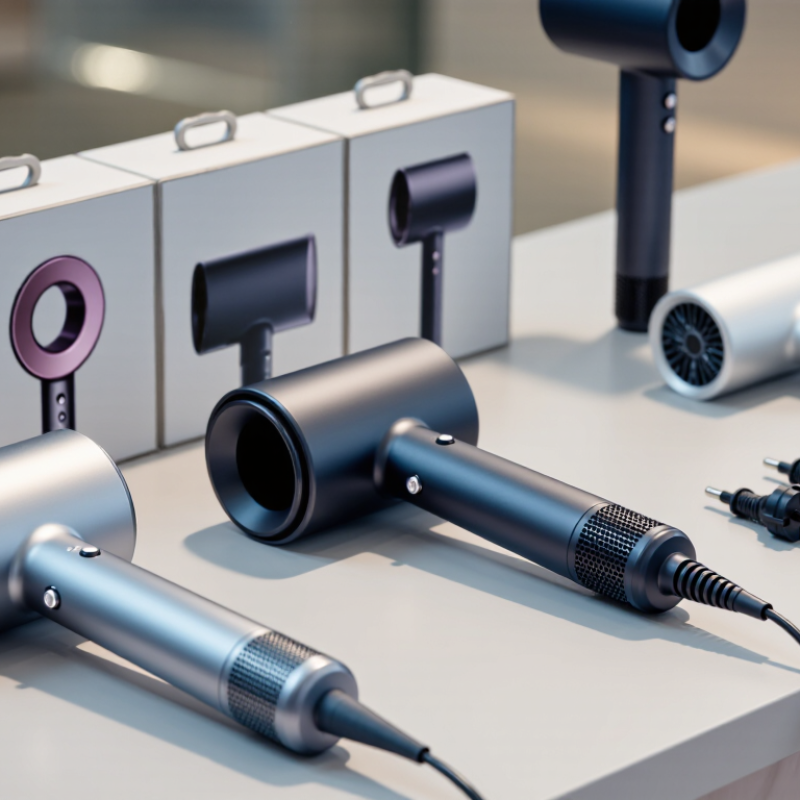
Define Buyer Segments and Shortlist Hair Dryers by Rated Power
Wholesale buyers should segment customers before comparing wattage. Salon distributors need dryers suited to repeated daily use; hotel buyers often prioritize simple controls, durable housings, and easy storage. Retailers serving home users may need several price points and clear heat settings. Grand View Research estimated the global hair dryer market at about USD 9.2 billion in 2023, with projected growth through 2030. That market estimate signals demand, but it does not tell buyers which power rating fits each channel.
Use rated input power as a shortlist filter, not a performance promise. U.S. Department of Energy appliance guidance places common hair dryers around 1,200–1,875 watts. A practical first screen is 1,200–1,500 W for lighter-duty or compact models, and roughly 1,600–1,875 W for everyday and frequent-use lines. Not always. Airflow, heat control, motor design, and build quality affect drying time too. Ask suppliers for test conditions, airflow figures, temperature settings, and continuous-use results; compare samples under the same conditions. Check voltage and plug specifications for each destination market, since a high-wattage model may not suit every outlet. I would not shortlist on watts alone. It is an easy shortcut, and sometimes the wrong one.
How to Choose Hair Dryers for Wholesale Buyers in 2026
Indicative rated-power bands for shortlisting by buyer segment (watts). These are planning ranges, not sales or market-share data.
Match rated power to the destination market’s voltage and plug requirements. Higher wattage alone does not guarantee stronger airflow or faster drying; compare airflow, heat settings, safety certifications, and intended use as well.
Verify Product Safety Against IEC 60335-2-23 and Local Regulations
For 2026 orders, ask suppliers for test reports covering IEC 60335-1 and IEC 60335-2-23. The latter applies to appliances for skin and hair care, including hair dryers. Check that the tested model matches the product you are buying, down to its motor, heating element, plug, and attachments. Request evidence for temperature rise, abnormal operation, electrical insulation, and protection against access to live parts. A certificate alone is not enough. It may cover a different model or an older standard edition.
Then check destination-market requirements. Voltage and plug type are only the start; labeling, electromagnetic compatibility, restricted substances, and required importer documentation may also apply. The European Commission’s Safety Gate 2023 report recorded 3,412 alerts across consumer-product categories. That figure is not specific to hair dryers, but it shows why traceable product records matter. Ask for the exact test laboratory, report number, date, and applicable standard edition. Verify them directly where possible. A clean-looking document can still leave gaps. I would also sample units from the production batch and check cord strain relief, intake grilles, and heat consistency during a supervised test. These checks add time, and they do not replace local compliance review.
Compare Motor, Airflow, Heat, and Noise Using Supplier Test Data
How to Choose Hair Dryers for Wholesale Buyers in 2026
Compare motor, airflow, heat, and noise under identical test conditions. Motor speed alone can mislead: high RPM does not guarantee strong airflow at the nozzle. Ask suppliers for airflow in metres per second, measured with the same attachment and setting. Also request drying time on a consistent hair sample. Small differences in distance or room humidity can skew results. The comparison is useful, but not perfect.
Heat deserves close attention. A 2011 study in Annals of Dermatology compared drying at 47°C from 15 cm, 61°C from 10 cm, and 95°C from 5 cm. Higher temperatures produced greater surface damage in the tested hair samples. Ask for outlet temperature and temperature at a stated distance, not just a “high heat” label. Check whether readings remain stable after repeated use. That matters.
Noise can change a salon’s daily comfort. Request decibel readings at a fixed distance, with the same speed and heat settings, and ask whether the figure is sound pressure or sound power. ISO 3744 describes methods for determining sound power from measured sound pressure. Supplier reports should name their test method and conditions. Listen to a sample unit too. Numbers miss tone and vibration. I would not rely on a single reading; production variation may make the quietest sample unrepresentative.
Match Voltage, Frequency, Plugs, and Labels to Each Target Market
A wholesale hair dryer can look correct in a product photo and still fail at the destination. Match its rated voltage to the market’s supply, and check frequency too. A dryer marked 220–240 V may not suit a 100–120 V market. Confirm the exact model specifications, not just a supplier’s general catalog.
Check plug type, pin layout, grounding, and cord length against the intended outlet and local requirements. A plug adapter does not convert voltage. That distinction matters.
For dual-voltage models, make sure switching instructions are clear and easy to follow. Frequency can affect motor operation and performance, so ask the manufacturer to confirm suitability for the destination supply. Small details, real consequences.
Labels should show the correct electrical ratings, warnings, model information, and instructions for the market. Language and formatting expectations can vary. Verify them with the importer and relevant local authorities before production; requirements may change, and assumptions are risky.
Request a production sample with its final plug and label, then compare both with the approved specifications. I have seen packaging reviewed carefully while the cord plug was overlooked. It happens. Keep written records of approvals and revisions, especially when one dryer is being prepared for several markets.
Check Landed Cost and RoHS’s 0.1% Lead Limit per Homogeneous Material
For 2026 wholesale dryer sourcing, compare landed cost, not factory price alone. Include unit price, tooling allocation, freight, insurance, duties, brokerage, inspections, and destination handling. A low-priced carton can become expensive after dimensional-weight charges or port storage. Request carton dimensions, gross weight, shipping terms, and a written cost breakdown. Small details matter.
RoHS limits lead to 0.1% by weight in each homogeneous material, not across the entire dryer. Relevant materials may include solder, cable insulation, plated contacts, and coatings; assess them separately. Request current declarations and test reports tied to the exact model and components. Check whether the product’s scope or an applicable exemption affects the assessment. A generic certificate may not cover a later component change. Keep records of approved versions and batches, and confirm revisions before shipment. Testing adds cost and time, so include both in your landed-cost estimate. That estimate can still be wrong. Allow room for delays or repeat checks rather than assuming every document will arrive perfectly.


