Get an instant quote
Get in touch Listen to our podcast

Blog

7 Tips for Choosing a Modern High Gloss Black Coffee Table

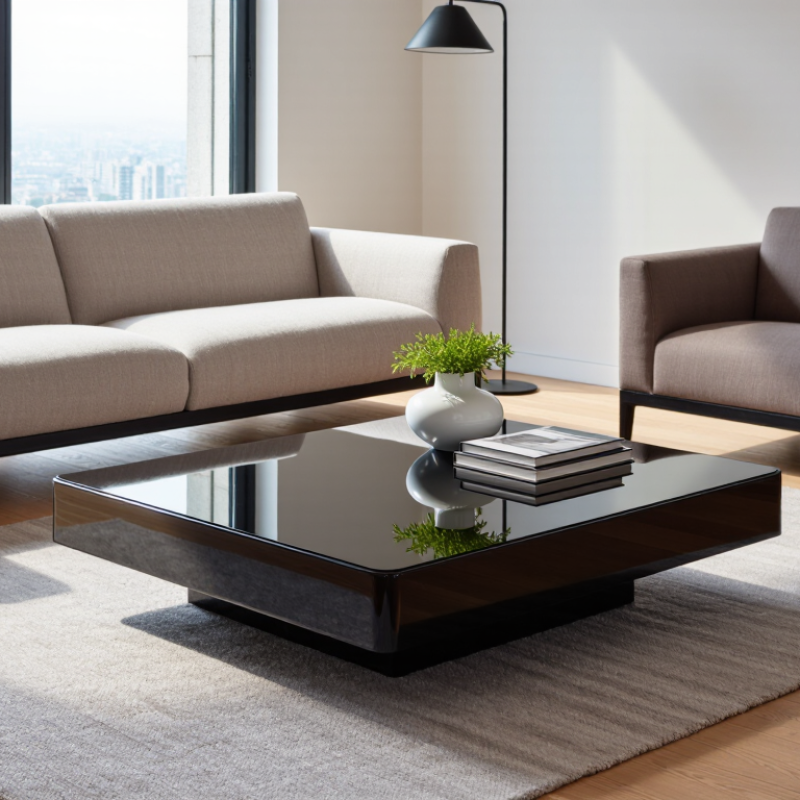
A Modern High Gloss Black Coffee Table can bring crisp contrast to a living room, but its reflective finish deserves careful thought. It catches window light, mirrors nearby colors, and can make a compact space feel more open. It also shows fingerprints, dust, and fine scratches more readily than many matte surfaces. That trade-off is easy to overlook in a showroom.

Interior designer Nate Berkus has said, “Your home should tell the story of who you are, and be a collection of what you love.” That idea is useful when choosing a centerpiece: style matters, but so should the way you live. Measure your seating area, check the table’s height against your sofa, and consider whether rounded corners suit your household. Look closely at the finish under natural light, not just bright store lighting. Ask about the tabletop material, weight capacity, assembly, and care instructions before buying.

Small details matter. A glossy top beside a sunny window may reflect glare; a sturdy base can feel reassuring on a busy evening. The seven tips ahead will help you compare proportions, construction, storage, maintenance, and design. They cannot remove every compromise. A dramatic surface may need more frequent wiping than you expect. That is worth admitting. Choose a table that fits your room and routines, rather than one that only looks striking in a photograph.
7 Tips for Choosing a Modern High Gloss Black Coffee Table

Define the Table’s Role and Measure Available Floor Space

Before choosing a modern high-gloss black coffee table, decide what it must do. Will it hold daily mugs and remotes, anchor a seating group, or stay mostly decorative? That answer shapes the needed surface area and storage. Measure the room, sofa, and walking routes—not just the empty patch in front of the sofa. The U.S. Census Bureau’s 2023 Characteristics of New Housing report puts the median floor area of new single-family homes at 2,286 square feet. That national figure is only context; it cannot tell you whether your living room has enough clearance.

Use painter’s tape to mark the table’s footprint, then walk around it with the usual chairs pulled out. A practical design guideline is to leave about 18 inches between the sofa and table, while keeping main routes comfortably open. Check drawers or lift-top lids, too; they need room to operate. Black gloss reflects windows and lamps, so test the taped shape at different times of day. Small rooms can feel tighter than measurements suggest. I would not trust a floor plan alone. Note the table’s full dimensions, including any projecting legs, and compare them with the space you actually use.

Match Table Height and Reach to Your Sofa’s Seat Dimensions

Measure your sofa before choosing a modern high gloss black coffee table. Record the seat height from the floor, including the cushion where you usually sit. A useful starting point is a table about one or two inches lower than the seat. This keeps a drink or book easy to reach without making the tabletop feel awkwardly high. Sofa cushions vary, though. A soft seat may sink when occupied, so check the height while someone is sitting down.

Reach matters just as much. Leave roughly 14 to 18 inches between the sofa edge and table, then test the space with your knees and a tray. Can you sit down without turning sideways? Can you place a mug down without leaning far forward? Good. In a compact room, a slightly narrower gap may work, but allow enough room to walk past safely. Measure from the sofa’s front edge, not its back or arm. That detail is easy to miss. Glossy black surfaces can make a table look visually prominent, so a comfortable reach helps it feel practical rather than imposing. Recheck your measurements after rearranging the sofa; even a small shift can change the clearance.

7 Tips for Choosing a Modern High Gloss Black Coffee Table

Match table height and reach to your sofa’s seat dimensions.

Use this planning guide to choose a table about 0–2 inches below the sofa seat. For comfortable reach, leave roughly 14–18 inches between the sofa and table. Measure your own sofa before buying; these are general guidelines, not fixed requirements.

Compare High-Gloss Finishes Using ISO 2813’s 60° Gloss Method

For a modern high-gloss black coffee table, compare finish readings rather than relying on showroom lighting. ISO 2813:2014 measures specular gloss in gloss units (GU) at defined angles. Its 60° method is the standard starting point for many coatings. Higher readings indicate stronger reflected gloss, not better scratch resistance. Important distinction.

Tip: Ask for the test angle and GU reading. Compare samples measured with the same instrument and setup. A reading of 85 GU at 60° may look noticeably brighter than 55 GU, but surrounding light and surface texture also affect appearance. Under a window, even small dust marks can stand out.

ISO 2813 advises using a 20° geometry for very glossy surfaces, typically above 70 GU at 60°, and an 85° geometry for very low gloss, typically below 10 GU. These checks help avoid misleading comparisons. Ask whether the seller’s figures come from calibrated measurements or visual estimates. Also inspect the table under side lighting; reflections can reveal waviness that a single number misses. The method measures gloss, not color consistency, coating thickness, or long-term wear. So a polished sample is useful, but it cannot tell the whole story.

7 Tips for Choosing a Modern High Gloss Black Coffee Table - Compare High-Gloss Finishes Using ISO 2813’s 60° Gloss Method

Seven-point buying and finish-comparison guide

Tip What to compare Practical check Useful data to record
1. Compare gloss with a measured value For comparable coated samples, request specular-gloss readings taken at the same angle. ISO 2813 specifies measurements at 20°, 60° and 85°. Use the 60° reading as the general comparison angle; ISO 2813 uses 20° for high-gloss surfaces and 85° for low-gloss surfaces when additional discrimination is needed. Record the measured value in gloss units (GU), the angle, the test method, and the sample tested.
2. Compare like with like Compare the same finish type and similar sample condition rather than relying on product photos or descriptions such as “ultra-gloss.” Ask whether the reading was taken on a flat, clean sample and whether it represents the actual table finish. Sample material; finish type; measurement angle; reported GU.
3. Inspect reflections in person Look at how clearly a straight object or window edge reflects in the black surface. Gloss level and surface waviness are different visual properties. Check the tabletop under both diffuse room lighting and a small, direct light source. Reflection clarity; visible waviness; lighting conditions used for inspection.
4. Check the finish construction Ask whether the visible surface is a coating, a laminated panel, an acrylic-faced panel, or glass. These constructions can differ in repair options and care requirements. Request the care instructions and warranty terms for the specific surface, not just for the table frame. Surface material; manufacturer-stated cleaning method; repair or replacement coverage.
5. Assess scratch and fingerprint visibility On a black reflective surface, fingerprints, dust and fine marks may be noticeable, but visibility depends on the finish, lighting and viewing angle. View a sample at normal room distance and handle it with clean hands before choosing. Observed fingerprint visibility; observed dust or fine-mark visibility; lighting conditions.
6. Match dimensions to the seating area Compare the table’s length, width and height with the available floor space and the height of the surrounding seats. Measure the intended placement area and check that circulation space and access to drawers or shelves remain practical. Table length × width × height; available floor area; seat height.
7. Check stability and everyday function Compare the base design, stated load capacity, edge treatment, storage and assembly requirements. Review the product’s documented specifications and confirm that the table sits level on the intended floor. Stated load capacity; base material; storage dimensions; assembly requirements.

ISO 2813 gloss-measurement comparison

Measurement detail What it means How to use it when comparing black finishes
Standard ISO 2813:2014 describes methods for determining specular gloss of non-metallic paint films at 20°, 60° and 85°. Confirm that the supplier’s reported method applies to the tested sample and that the sample represents the offered finish.
60° geometry The general-purpose angle used for gloss measurement; the result is reported in gloss units (GU). Compare 60° readings only with other 60° readings taken using a consistent method. A GU value is not a percentage.
20° geometry An additional angle used to better distinguish surfaces with high gloss. Useful when two high-gloss samples have similar 60° readings and a more discriminating comparison is needed.
85° geometry An additional angle used to better distinguish surfaces with low gloss. Generally less relevant for selecting a visibly high-gloss tabletop, but useful for low-gloss comparison.
Reading record Gloss measurements are specific to the tested surface and conditions; ISO 2813 is a measurement method, not a universal product-rating scale. Request the actual GU result, measurement angle, test method and sample identification. Do not treat an unverified label such as “high gloss” as a measured value.

Comparison note: There is no single ISO 2813 GU value that guarantees a particular appearance on every black coffee table. Use measured readings alongside a physical sample, reflection inspection, care requirements and the table’s documented dimensions.

Check Table Strength and Durability Against EN 12521:2023

A glossy black coffee table can look substantial while hiding a light frame or weak joints. Check its strength against EN 12521:2023, a standard covering safety, strength, and durability requirements for domestic tables. Ask whether the exact model was tested, not just a similar design. Small details matter.

Look for a dated test report that identifies the table and describes the assessment. Check the frame, leg connections, and underside; loose fittings or thin support rails deserve questions. Also confirm the stated load limit and whether it applies evenly across the top.

A standard-based test offers useful evidence, but it cannot predict every spill, impact, or uneven floor.

At home, place the table on a level surface and press gently near each corner. It should not rock, creak, or shift. That quick check is imperfect, not a replacement for testing. High-gloss finishes can make small scratches and dust easier to notice, so inspect the edges and coating under natural light. If a seller cannot provide clear testing information, treat that as a reason to compare other options.

Review Edge Safety, Cleaning Needs, Assembly, and Warranty

Tip 1: Check the corners and edges before buying. A rounded profile is less likely to cause painful bumps, while chipped veneer can leave a hard edge exposed. Stability matters, too. The U.S. Consumer Product Safety Commission estimated 22,500 emergency-room-treated injuries from furniture and television tip-overs in 2018. That figure covers many furniture types, not coffee tables alone, but it is a useful reminder to check for a solid base and secure joints.

Tip 2: Treat a glossy black finish as a high-visibility surface. Fingerprints and dust show quickly under window light. Use a soft microfiber cloth, then a slightly damp one for sticky marks; avoid abrasive pads unless the care instructions specifically allow them. Gloss looks pristine in product photos. Real rooms are less forgiving. EPA guidance notes that indoor pollutant levels can be two to five times outdoor levels, so ventilate the room when unpacking and assembling new furniture. This is general indoor-air guidance, not a measurement of any particular table.

Tip 3: Before assembly, check that the parts and hardware match the instructions. Tighten fasteners evenly, and ask someone to steady the top; forcing a misaligned screw can damage the finish. Keep the receipt and warranty details. Check whether coverage includes peeling finish or loose joints, and note exclusions for heat, spills, or normal wear. Small detail. A coaster is cheaper than a repair.

CNC machining CAD export file formats

Put your parts in production today

Get an instant quote