How to Buy Lifted Golf Carts in 2026?
Buying a Lifted Golf cart in 2026 is not just a style decision. It affects ride height, handling, storage, and daily comfort. A taller stance can help on uneven private paths, but it may also make entry harder. Small trade-offs matter. Before comparing listings, decide where the cart will travel, how many people it must carry, and what you plan to haul. Measure your garage opening and storage space. Inspect the tires, suspension, steering, battery, charger, and service records. Then take a test drive on surfaces like the ones you use. A polished photo proves very little.
Lifted Golf buying-guide specialist Riley Carter offers this practical reminder: “Buy for your route and routine, not for the tallest stance on the lot.” This is an illustrative editorial quote, not a statement from a verified interview. Use it as a starting point, not a substitute for inspection. Compare lift quality, tire size, braking feel, available parts, and seller support. Ask what modifications were made and whether maintenance records support the seller’s claims. If the cart pulls to one side or rattles over a small bump, pause and investigate. It may be a minor issue. It may not. This guide will help you weigh those details, compare new and used options, and choose a lifted cart that suits your actual needs—not just the one that looks impressive in the driveway.
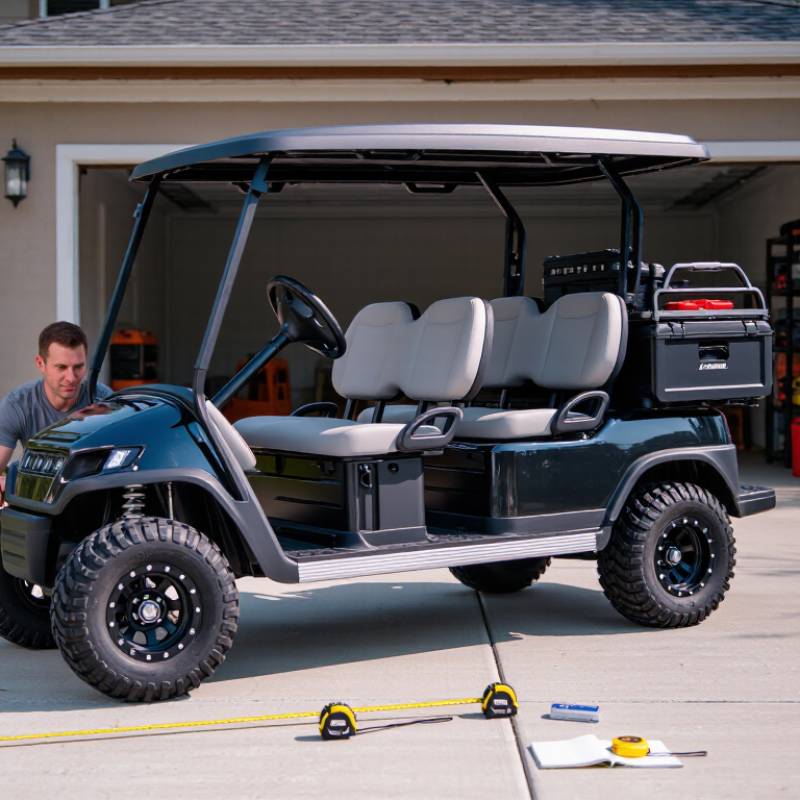
Determine Your Needs and Intended Use for a Lifted Golf Cart
How to Buy Lifted Golf Carts in 2026?
Determine Your Needs and Intended Use for a Lifted Golf Cart
Before choosing a lifted golf cart, picture where it will travel most often. A sandy path, uneven yard, and paved community road place different demands on a cart. Note the steepest slope, narrowest gate, and roughest surface you expect to encounter. That matters. Extra ground clearance may help on rutted paths, but a taller cart can feel less stable on sharp turns. Lift is not automatically better.
Think about who and what the cart must carry. Count regular passengers, then add coolers, garden supplies, or sports gear to your estimate. Check the cart’s rated capacity rather than judging by seat space alone. If children or older passengers ride often, easy entry, handholds, and a smooth ride may matter more than aggressive tires. Measure twice. A wide tire setup may not fit through a shed door or between storage posts.
Also consider how far you travel and where the cart will be stored. Long outings make battery range and charging access important; frequent short trips may not. Ask a seller to explain how the lift, tires, and suspension affect handling, and request a test drive on similar terrain when possible. I would reconsider any setup that looks impressive but feels awkward to park or turn. Your real routine is a better guide than a dramatic photo.
Compare Lift Heights, Powertrains, and Safety Features
How to Buy Lifted Golf Carts in 2026?
Compare lift heights by actual loaded ground clearance, not just the lift-kit label. A three-inch lift may suit uneven paths; a taller setup can raise the center of gravity and make cornering feel less settled. Small differences matter. Ask for the cart’s measured height, tire size, braking details, and stability checks. The U.S. Consumer Product Safety Commission’s NEISS analysis estimated about 13,000 golf-cart-related emergency-department visits annually from 2007 to 2012. That figure covers golf carts broadly, not lifted models, but it underlines why safety deserves more than a quick visual check. Review the applicable ANSI/ITSDF B56.8 safety guidance with a qualified seller.
Electric powertrains are quiet and avoid fuel stops, but confirm charging access and range on your actual hills and passenger load. Gas models can be refueled quickly, yet bring engine noise, exhaust, and routine engine maintenance. Neither choice is automatically better. Check how the cart stops with passengers aboard, and inspect tire load ratings, lights, mirrors, and seat-belt provisions. A tall stance looks capable. It may also feel twitchier than expected. Test-drive over a safe, uneven route before buying, and ask for written maintenance and inspection records.
How to Buy Lifted Golf Carts in 2026? - Compare Lift Heights, Powertrains, and Safety Features
Typical lifted-cart configurations and buying considerations. Tire fitment and performance depend on the cart’s make, model, year, and installed components. | Lift Setup | Typical Tire Size | Best Suited For | Powertrain Considerations | Safety and Fitment Checks |
| About 3-inch lift | Often around 20–23 inches in overall tire diameter; confirm clearance at full steering lock. | Uneven paths, grass, and light trail use while keeping a relatively low step-in height. | 48-volt electric or a small four-stroke gasoline engine can suit light-duty use. Choose based on charging access, passenger load, and local operating rules. | Check tire-to-body clearance, steering movement, brake condition, and whether the lift kit is designed for the exact cart configuration. |
| About 4-inch lift | Often around 22–25 inches in overall tire diameter, subject to wheel offset and suspension design. | Regular use on rougher paths and moderate obstacles; a common middle ground for added clearance. | A 48-volt system may work well for typical short trips. For frequent hills or heavier loads, compare controller, motor, battery, and gearing capacity—not voltage alone. | Verify alignment, suspension travel, brake performance, and that larger tires do not rub during turns or compression. |
| About 6-inch lift | Often around 23–27 inches or larger, but compatibility varies considerably by cart and wheel package. | More demanding terrain where added ground clearance is needed; increased height can make entry and handling less convenient. | Consider a powertrain and gearing suitable for the intended load and terrain. Larger tires can increase the demand on the motor, controller, engine, and brakes. | Inspect the complete suspension and steering setup, tire clearance, braking capacity, and stability. Do not assume a taller lift improves safe road handling. |
Powertrain comparison for lifted carts | Powertrain | Typical Advantages | Trade-offs | What to Check Before Buying |
| 48-volt electric | Quiet operation and no tailpipe emissions while driving. Convenient where charging is available. | Driving range depends on battery condition and type, terrain, load, speed, and tire size. Lead-acid batteries require routine care; lithium systems have different charging and replacement requirements. | Ask for battery age and type, charger compatibility, controller and motor specifications, and an estimate based on your expected terrain and passenger load. |
| Higher-voltage electric system | May be configured to provide stronger performance, depending on the motor, controller, battery, and gearing. | Voltage alone does not establish power, range, or hill-climbing ability. Components and chargers must be matched to the system. | Confirm that the battery, motor, controller, wiring, charger, and any conversion work are compatible and properly installed. |
| Four-stroke gasoline | Can be refueled quickly and does not depend on access to an electrical charging point. | Produces exhaust and engine noise and needs fuel and routine engine maintenance. Operating restrictions vary by location. | Check engine condition, service history, fuel-system condition, brakes, and whether gasoline carts are permitted where you plan to drive. |
Before purchase: Request the cart’s model year, serial number, lift-kit details, tire and wheel specifications, and maintenance records. Confirm local rules for road use; a lifted cart is not automatically street legal. Seat belts, lights, mirrors, turn signals, and other required equipment depend on the cart and jurisdiction.
Set a Budget and Evaluate New, Used, and Custom Options
How to Buy Lifted Golf Carts in 2026?
Set a budget before comparing listings. Include more than the purchase price: delivery, a weather enclosure, replacement tires, and battery work can add up quickly. Decide where the cart will travel, too. A lifted cart may handle uneven paths better, but larger tires can affect ride comfort and battery range. Small details matter.
New carts offer a known starting condition and clearer equipment specifications, which can make cost planning easier. Ask for written details on battery type, suspension components, warranty coverage, and included accessories. Used carts may cost less, but inspect the frame for corrosion, check that the brakes stop smoothly, and look for uneven tire wear. Ask how the battery has been maintained, then arrange an independent inspection if its condition is uncertain. A clean seat does not prove the cart was well cared for.
Custom builds can match specific needs, such as extra seating or storage, but every upgrade should earn its place in the budget. Request an itemized quote and confirm how changes affect handling, range, and service access. Compare the total cost with a suitable new or used cart, not just the base price. It is easy to overestimate how often you will use a premium feature. Test-drive the cart on terrain similar to your usual route, and keep some budget aside for repairs.
Get it inspected.
Inspect the Cart, Verify Its History, and Check Local Rules
A lifted golf cart can look ready for the trail while hiding costly wear. Inspect it in daylight, on level ground, and ask the seller to let it cool before starting. Look underneath. Check the frame for cracks, fresh paint, rust, and bent brackets around the lift kit. Uneven tire wear, loose steering, or a cart that pulls to one side can point to alignment or suspension problems. Test the brakes, lights, horn, and battery or fuel system. A short ride is useful, but it will not reveal every fault.
Verify the cart’s identity and history before paying. Match the serial number on the cart with the paperwork, and request service records, receipts, and details of lift or suspension changes. Ask when the batteries were installed, if applicable, and whether the charger is included. Ask for proof. A polished body is not evidence of careful maintenance, and a missing record may have an ordinary explanation—but it deserves a clear answer. If anything feels uncertain, arrange an inspection by a qualified mechanic.
Check local rules before assuming the cart can travel on public roads. Requirements can vary by location and may depend on equipment, speed, registration, or where the cart will be driven. Contact the relevant local transport office or municipality and confirm the rules for your intended route. Do not guess. A cart that is permitted in one neighborhood may not be allowed on a nearby road. I would verify this before negotiating, not after discovering the route is unusable.
Compare Sellers, Confirm the Warranty, and Complete the Purchase
A lifted golf cart can look ready for the trail, but compare the details behind the photos. Ask each seller for an itemized quote showing the lift height, tire size, battery type, delivery cost, and any setup fees. Check that steering feels steady and brakes respond evenly during a test drive. Look closely at welds, tire wear, and the underside for damage. Small details matter.
Compare sellers by how clearly they answer questions, not just by price. Ask who performs repairs and how warranty claims are handled. Request the warranty in writing, including its duration and coverage for the batteries, motor, controller, lift components, and labor. Some parts may be excluded or treated as wear items. It is easy to miss. Confirm whether changes made after delivery could affect coverage. Before paying, match the cart’s serial number to the paperwork and keep a copy of the quote, warranty, and receipt. At delivery, photograph existing marks and test the lights, horn, brakes, and steering. I would slow down here. A rushed handoff can leave small questions unresolved.


