Get an instant quote
Get in touch Listen to our podcast

Blog

7 Best Voltage Instruments for Accurate Measurement

Choosing a Voltage Instrument is not simply a matter of picking the highest resolution. A handheld digital multimeter may suit field checks, while a bench meter can offer greater stability for repeated measurements. An oscilloscope reveals changing waveforms that an ordinary meter may average or miss. The right choice depends on the signal, environment, and required uncertainty.

Measurement quality needs more than a clear display. NIST Technical Note 1297 explains how measurement uncertainty is evaluated and reported, including contributions from calibration, repeatability, and resolution. In practical terms, a meter showing 12.00 volts does not guarantee that the true value is exactly 12.00 volts. Probe contact, electrical noise, and instrument condition all matter. Small details count.

Safety ratings matter too. IEC 61010-1 sets general safety requirements for electrical measurement equipment, while the applicable measurement category should match the installation. A non-contact voltage detector can help identify a live conductor, but it is not a substitute for a properly rated meter when an actual voltage reading is needed. That distinction is easy to overlook.

This guide compares seven instrument types by accuracy, usability, safety, and typical application. It considers digital multimeters, bench meters, oscilloscopes, voltage testers, and other practical options. No single instrument wins every task. Some trade portability for stability; others are convenient but provide limited measurement detail. The comparisons aim to make those compromises visible, though the best choice still depends on your own setup.
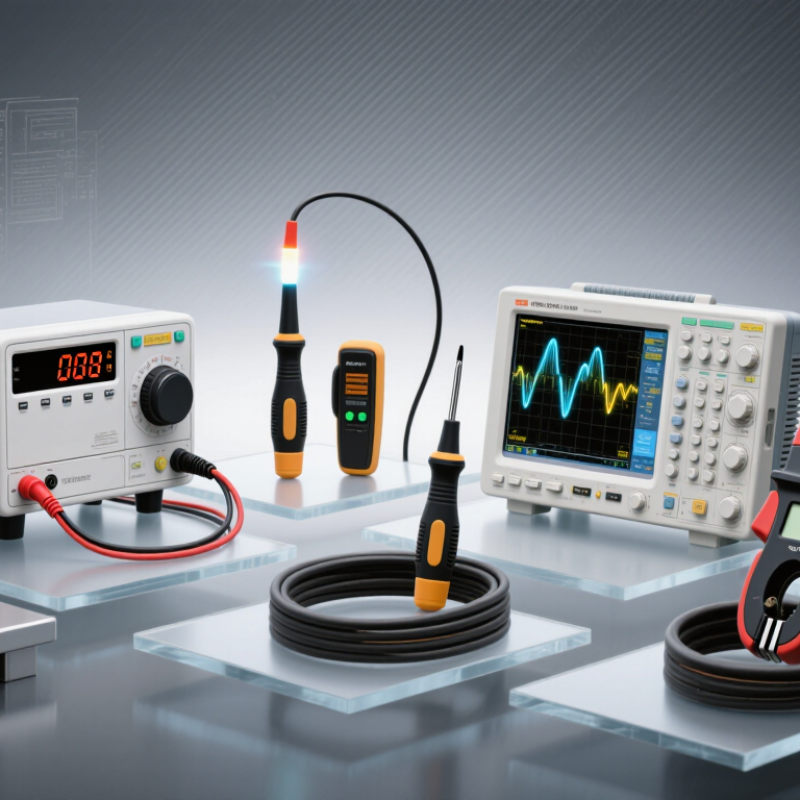
7 Best Voltage Instruments for Accurate Measurement

What Voltage Instruments Measure and How They Work

Voltage instruments measure the electrical potential difference between two points, expressed in volts. A digital multimeter typically connects across a circuit and uses a high input resistance to limit its effect on the reading. Inside, circuitry scales the input before an analog-to-digital converter turns it into a displayed value.

An oscilloscope also measures voltage, but shows how it changes over time, making brief spikes or ripple visible.

A non-contact detector is different: it can indicate an electric field, but generally cannot provide a dependable numerical voltage reading.

The reading depends on more than the screen. AC mode, probe contact, frequency range, and meter accuracy can all affect the result. For changing signals, a basic meter may not capture the waveform’s true effective value.

NIST’s 2019 SI Brochure gives the elementary charge as exactly 1.602176634 × 10⁻¹⁹ coulomb, a fixed value in the modern SI system that supports precision electrical measurement. Calibration links working instruments to reference standards; IEC 61010 sets safety requirements for measurement equipment and circuits.

Check the instrument’s measurement category and rating before probing a panel. Small details matter. I have also found that a stable-looking display can invite too much confidence: repeat the measurement, inspect the leads, and note the range used.

Key Features That Affect Measurement Accuracy

7 Best Voltage Instruments for Accurate Measurement

Key Features That Affect Measurement Accuracy

Voltage accuracy depends on more than the number of digits on a display. A handheld digital multimeter suits many routine checks, while a bench meter can offer finer resolution for stable, low-voltage work. For each instrument, check its stated accuracy across the range you plan to use. A meter may be precise at one range and less so at another. Small details count.

Input impedance can affect the circuit being measured. A high-impedance meter usually draws less current, which helps avoid disturbing sensitive electronic signals. Resolution matters too, but extra display digits do not guarantee a more accurate reading. That can be misleading. Compare the instrument’s accuracy specification, resolution, and measurement range together. For changing signals, a data logger or meter with suitable sampling can reveal brief fluctuations that a slow display might miss.

Calibration status, probe condition, and temperature also shape results. Worn leads or loose connections can add resistance, so inspect the tips and confirm a firm contact before recording a reading. In practical work, readings that seem inconsistent deserve a second check with a known reference source. Even then, uncertainty remains; specifications describe performance under defined conditions, not every real-world setup. Choose safety-rated equipment for the environment, and never exceed its marked limits.

Seven Types of Voltage Instruments and Their Uses

Voltage instruments differ in what they reveal, how they connect, and where they work best. An analog voltmeter uses a moving needle to show voltage changes; it suits basic checks where a quick visual trend matters. A digital multimeter measures voltage alongside other electrical values, making it useful for troubleshooting circuits. Its accuracy depends on the selected range and correct probe placement. Small details matter.

A non-contact voltage detector senses an electric field without touching a conductor. It is handy for preliminary checks, but it cannot confirm that a circuit is safe to handle. A two-pole voltage tester touches two points and gives a direct indication of potential difference, often helping verify a supply or check isolation. Follow the instrument’s rating and test it on a known live source before and after use. That step is easy to skip.

For changing signals, an oscilloscope displays voltage over time, revealing pulses, noise, and waveform shape. A high-voltage probe scales down hazardous voltages so compatible instruments can measure them; use only a properly rated probe and follow its instructions. A panel-mounted voltmeter stays installed in equipment, providing a continuous reading for operators. No single tool fits every task. The right choice depends on the signal, measurement range, and working conditions—and those are worth checking twice.

How to Choose the Right Instrument for the Job

Choosing a voltage instrument starts with the circuit, not the tool’s feature list. Check the expected voltage, whether it is AC or DC, and the measurement environment. A handheld digital multimeter suits general troubleshooting, while a bench multimeter offers stable readings for repeated tests. An analog voltmeter can make changing readings easier to follow, though its scale takes practice.

For current, a clamp meter may also measure voltage through test leads; its clamp function does not replace a voltage reading. A high-voltage probe must match the meter’s input and rating. A non-contact voltage detector is useful for quick screening, but it cannot provide a precise voltage value. A voltage data logger helps track changes over time, and a dedicated panel voltmeter supports continuous monitoring. That makes seven useful options, but none fits every job. Check the instrument’s category and voltage rating against the circuit, inspect leads for damaged insulation, and use the correct input terminals. Small details matter. In practice, even a familiar meter can mislead when its range or connection is wrong; pause and verify the setup.

7 Best Voltage Instruments for Accurate Measurement — How to Choose the Right Instrument for the Job

The ranges and accuracy figures below are representative of common instrument types, not guaranteed specifications. Actual performance depends on the selected range, input conditions, calibration, probes, and the instrument’s datasheet.

Instrument Type Typical Measurement Range Representative Accuracy Best Suited For Key Selection Considerations
Handheld Digital Multimeter Millivolts to approximately 1,000 V DC; AC ranges vary by model Often about ±0.05% to ±0.5% of reading on DC voltage General electrical troubleshooting, field service, and routine bench checks Check voltage and frequency limits, input impedance, safety category, and whether AC accuracy is specified across the required frequency range.
Precision Bench Digital Multimeter Microvolts or millivolts to approximately 1,000 V, depending on the model Often about ±0.002% to ±0.02% of reading on DC voltage under specified conditions Calibration work, component characterization, and stable laboratory measurements Review the full accuracy specification, integration time, temperature coefficient, calibration interval, and input-terminal limits.
Panel-Mount Voltmeter Commonly designed for a defined low-voltage range, such as 0–10 V, 0–100 V, or 0–600 V Often around ±0.1% to ±1% of full scale Continuous voltage monitoring in control panels, power systems, and equipment Match the input range and AC/DC type; verify isolation, display resolution, environmental rating, and whether an external sensor or divider is required.
Electrostatic Voltmeter Ranges vary widely; specialized instruments can measure from hundreds of volts to tens of kilovolts Model-dependent; commonly specified as a percentage of reading or full scale Measuring high voltage with minimal loading, including on sensitive or high-impedance sources Check probe distance, target size, surface conditions, calibration geometry, and the instrument’s maximum voltage rating.
High-Voltage Divider with a Meter From kilovolts to hundreds of kilovolts, depending on divider design Often about ±0.1% to ±1% ratio uncertainty for suitable calibrated systems Reducing high voltage to a measurable level for testing and monitoring Confirm divider ratio, voltage and power ratings, frequency response, insulation clearances, grounding method, and calibration traceability.
Differential Probe and Oscilloscope Low-voltage signals to high-voltage transients; limits depend on probe attenuation and frequency Probe gain accuracy is commonly specified separately; measurement error may be a few percent or more Viewing changing, pulsed, or floating voltages and comparing two points without grounding either point to the scope Choose adequate differential and common-mode voltage ratings, bandwidth, attenuation, input capacitance, and common-mode rejection.
Data Acquisition Voltage Input Common input ranges include ±1 V, ±10 V, and ±100 V; larger signals may need conditioning Often specified as a percentage of full scale, with additional offset and gain error Logging multiple voltage channels over time or collecting measurements for analysis and automation Compare resolution with total accuracy; also check sampling rate, channel isolation, input impedance, noise, and synchronization requirements.

Safe Techniques for Accurate Voltage Measurement

Accurate voltage readings begin before probes touch a circuit. Choose an instrument suited to the task, such as a digital multimeter, clamp meter with a voltage function, or non-contact tester. A non-contact tester can flag energized wiring, but it cannot confirm that a circuit is safe. For contact measurements, check the instrument’s voltage and category ratings against the work area. Inspect leads for cracked insulation. Small damage matters.

Set the meter to AC or DC correctly, then select a range above the expected voltage. Place probes across the two points being measured, keeping fingers behind their guards. Do not let exposed probe tips touch each other or nearby metal. When checking a potentially live circuit, use appropriate protective equipment and follow site procedures. Verify the meter on a known source before and after testing, when practical. This helps catch a dead battery or failed lead that could cause a false reading.

Keep the work area dry, stable, and well lit. If a reading seems unexpected, stop and reassess rather than probing faster. Even careful people rush. Contact quality, meter accuracy, and circuit conditions can all affect the result, so note the setup when comparing readings. For unfamiliar or high-energy equipment, ask a qualified technician to perform the measurement.

Voltage Instrument Accuracy: Representative Typical Values

Illustrative stated DC measurement accuracy by instrument type. Lower percentage indicates a smaller stated measurement error; actual specifications vary by model, range, calibration, and measurement conditions.

Safe measurement: Check the instrument and probe voltage limits and measurement-category ratings before connecting. Use properly rated, undamaged leads, and follow the instrument’s instructions. Oscilloscope accuracy depends on the probe and setup, so its value is not directly interchangeable with a multimeter specification.

CNC machining CAD export file formats

Put your parts in production today

Get an instant quote