Get an instant quote
Get in touch Listen to our podcast

Blog

7 Best Concrete Screws for Reliable Anchoring

A concrete screw may look simple: a steel shaft, sharp threads, and a hex or flat head. Its reliability depends on more than appearance. Concrete strength, drilled-hole diameter, embedment depth, edge distance, and installation technique all matter. Structural engineer David Darwin’s research on concrete design supports a practical takeaway: an anchor works as part of a system, not by itself. That is worth remembering when comparing the 7 Best Concrete Screws for Reliable Anchoring.

The right Concrete Screws should match the job. A light-duty bracket on a garage wall needs different holding capacity from a ledger or equipment support. Check the manufacturer’s published load data and installation instructions, including the required drill-bit size and minimum embedment. Dust left in the hole can also reduce dependable engagement. Small details matter.

Look closely at the screw’s coating, head style, thread design, and approved base materials. Then consider the tool you will use; a screw driven too fast can strip its hole or sit proud of the surface. No product can rescue poor preparation. Even careful installers can make mistakes, so inspect the finished connection and verify it suits the expected load. This guide compares seven options by practical features, installation demands, and intended uses. It is a useful starting point, not a substitute for checking current product specifications or getting qualified advice for critical applications. A little doubt is healthy.
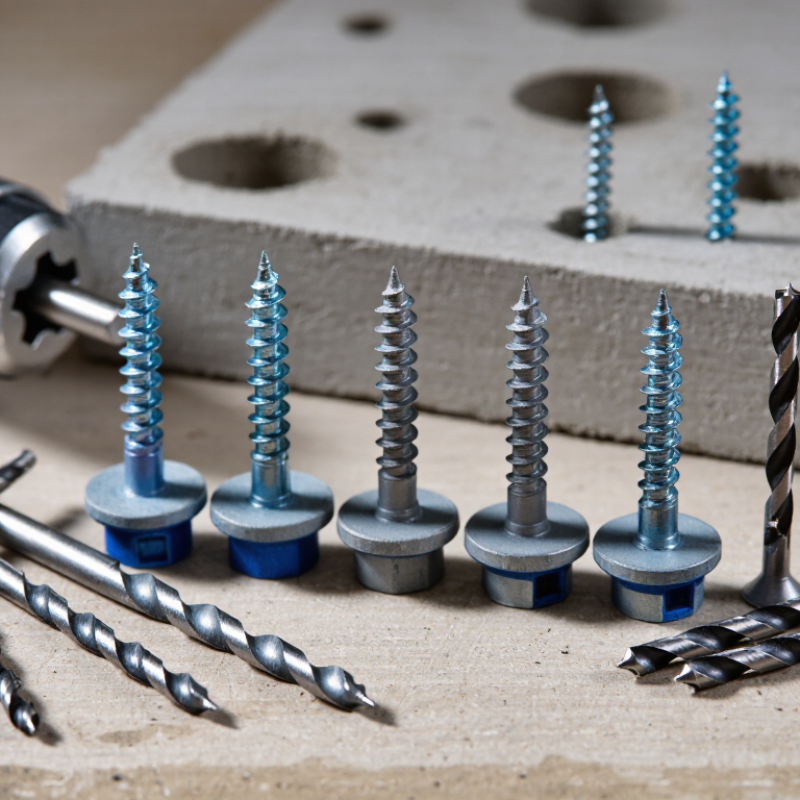
7 Best Concrete Screws for Reliable Anchoring

Concrete Screw Anatomy: Thread Design, Diameter, and Embedment Depth

A concrete screw’s holding power begins with its thread design. Unlike a nail, it forms a mechanical grip inside a drilled hole. The threads must match the screw’s intended use and the concrete’s condition. Deep, sharp threads can bite firmly, but dust left in the hole may weaken that grip. Clean the hole as directed. Small details matter.

Diameter affects both strength and installation. A larger screw may support a heavier load, yet it also needs a correctly sized hole and enough concrete around it. Too close to an edge, even a stout screw can contribute to cracking. Check the required bit size rather than guessing. A hole that feels snug is not necessarily the right hole.

Embedment depth is the length of screw set into sound concrete, not the portion above the surface. Follow the specified minimum and maximum depth for the fastener and application. Going too shallow can reduce engagement; drilling much deeper does not automatically improve holding power. I would double-check the measurement after accounting for the fixture’s thickness. That step is easy to overlook. Also consider spacing, concrete condition, and the load direction, since these affect performance alongside screw anatomy.

ICC-ES AC193: Qualification Data for Anchors in Cracked Concrete

A concrete screw may look simple, but its performance depends on more than diameter and thread shape. ICC-ES AC193 provides a framework for evaluating mechanical anchors in concrete, including use in cracked concrete when the applicable report covers that condition. A crack can reduce the concrete’s grip around an anchor. That matters.

Qualification data can show tested load capacities, embedment depths, concrete strengths, and installation limits. Check whether the evaluation report specifically permits cracked-concrete use; a general strength figure is not enough. Look closely at edge distances, spacing, drill-bit size, and required tightening procedures. Small details matter here. A hole drilled too wide or an anchor set too close to an edge may not match the tested installation.

For a reliable comparison, match the report’s conditions to the actual slab and expected loads. Check tension and shear values separately, and account for any required safety factors through the project’s design process. I would not choose an anchor from a headline rating alone; the fine print can change the decision. Reports also cannot cover every jobsite variation, so inspect the concrete and follow the stated installation instructions. A neat table helps, but it does not replace careful field judgment.

Compare Seven Concrete Screws by Published Tension and Shear Loads

7 Best Concrete Screws for Reliable Anchoring
Compare Seven Concrete Screws by Published Tension and Shear Loads

Published tension and shear loads offer a practical starting point when comparing seven concrete screws. Tension measures resistance to pullout; shear measures resistance to sideways force. A high rating in one direction does not guarantee strong performance in the other. Check each published value alongside screw diameter, embedment depth, concrete strength, and installation conditions. Otherwise, a neat comparison table can be misleading.

Tips: Compare like with like. Confirm whether figures describe ultimate strength or allowable load, and follow the manufacturer’s installation instructions. Small differences in drilled-hole depth can matter.

Concrete strength and edge distance affect real anchoring performance. So can cracked concrete, spacing between fasteners, and the quality of the drilled hole. I would avoid declaring one screw the “best” from a single load figure. The published data may use different test conditions, which makes direct ranking imperfect. Choose a screw with suitable ratings for both expected loads, then verify the design with project-specific guidance. When loads are critical, consult a qualified professional rather than relying on a headline number alone.

ACI 318 Chapter 17: Check Edge Distance, Spacing, and Embedment

7 Best Concrete Screws for Reliable Anchoring

A reliable concrete screw is only as dependable as its installation geometry. ACI 318-19 Chapter 17 requires anchor design to consider tension, shear, concrete strength, edge distance, spacing, and embedment. These checks matter because a screw near a slab edge can trigger concrete breakout before the steel reaches its capacity. Small details matter.

ACI’s design provisions evaluate projected concrete breakout areas, which can shrink when anchors sit close to edges or each other. That means two screws with identical diameters may not provide the same group capacity. Check the product’s current ICC-ES Evaluation Report for tested installation limits, including minimum spacing, edge distance, and effective embedment. ACI 355.2 qualification data supports evaluation of post-installed mechanical anchors, but it does not replace project-specific design. Read the report carefully.

On site, measure from the actual concrete edge, not a chipped corner or a pencil mark. Confirm the specified hole depth and remove drilling dust; debris can prevent full embedment. Then compare the installed layout with the design drawings. I would recheck it. A rushed measurement is easy to miss, and an anchor that looks secure may still fail the required edge-distance check.

ASTM E488/E488M: Verify Anchor Tension and Shear Test Results

7 Best Concrete Screws for Reliable Anchoring
ASTM E488/E488M: Verify Anchor Tension and Shear Test Results

A concrete screw’s published load rating is only useful when its test conditions match the job. ASTM E488/E488M provides methods for measuring anchor strength under tension and shear in concrete. Read the full test report, not just a peak-load figure. Small details matter. Check the concrete strength, embedment depth, edge distance, and installation procedure used for each test.

ACI 355.2-22 sets qualification requirements for post-installed mechanical anchors, while ICC-ES AC193 covers acceptance criteria for mechanical anchors in concrete. These references help frame what credible test documentation should show: specimen counts, measured loads, failure modes, and whether concrete was cracked or uncracked. Compare tension and shear results separately. A high tension result does not establish strong shear performance.

Field conditions are rarely perfect. A hole may be dusty, or a screw may be installed near an edge. Those differences can change performance, so a laboratory result is not a guaranteed job-site capacity. ASTM test strength is also not the same as allowable design load; design checks must account for applicable safety factors and load interactions under ACI 318, Chapter 17. If a report omits key setup details, treat the number cautiously. That is easy to overlook.

7 Best Concrete Screws for Reliable Anchoring - ASTM E488/E488M: Verify Anchor Tension and Shear Test Results

The profiles below are generic selection options, not ranked or tested products. Concrete-screw dimensions and capacities vary by manufacturer. ASTM E488/E488M results are product- and installation-specific; no universal tension or shear capacity can be assigned to a diameter alone.

Selection profile Nominal diameter Typical application Length and embedment selection ASTM E488/E488M tension and shear results
Small-diameter, light-duty profile 3/16 in (4.8 mm), where offered Light fixtures or supports in sound concrete, subject to the product’s published limits Choose a listed length that passes through the fixture and provides the specified embedment. No universal value. Obtain the exact anchor’s test report for the specified concrete and installation conditions.
General-purpose profile 1/4 in (6.4 mm) Common fixture and bracket anchoring where the selected anchor is approved for the intended load. Follow the manufacturer’s listed embedment, hole diameter, and installation instructions. Check reported tension and shear test data for the specific anchor configuration; do not infer capacity from diameter.
Longer-length general-purpose profile 1/4 in (6.4 mm) Applications with a thicker fixture, provided required embedment and edge distances can be maintained. Extra overall length does not automatically mean greater capacity; verify effective embedment in the listing. Request results matching the embedment, concrete condition, and loading direction used in design.
Medium-duty profile 3/8 in (9.5 mm), where offered Heavier brackets or equipment supports when engineering checks and product data permit. Confirm the listed embedment and minimum member thickness; avoid unverified installation near edges. Verify the report’s tension and shear results, failure modes, and test setup for the selected size.
Longer medium-duty profile 3/8 in (9.5 mm), where offered Thicker attachments or deeper listed embedment, if permitted by the anchor’s published installation range. Use only a listed length and embedment; check drilling depth and concrete member thickness. No product-specific test values are provided here. Obtain the applicable test report before assigning design capacity.
Large-diameter profile 1/2 in (12.7 mm), where offered Potentially demanding anchorage applications requiring project-specific engineering and a suitable listed anchor. Check the product’s approved embedment, spacing, edge distance, and minimum concrete thickness. Require test data for the exact anchor size and installation condition; larger diameter alone does not establish capacity.
Corrosion-resistant material or coating profile Select from listed sizes, commonly including 1/4 in or 3/8 in options Locations where the exposure environment requires a specified corrosion-resistant material or coating. Select length and embedment from the exact product documentation; confirm suitability for the exposure. Confirm that test data and any applicable qualification cover the exact material, coating, size, and installation condition.

Verification checklist: obtain the product-specific ASTM E488/E488M report; confirm whether tests used cracked or uncracked concrete, concrete compressive strength, embedment, edge distance, spacing, and installation procedure; review tension and shear results and observed failure modes. Use applicable design values and installation instructions rather than treating laboratory test results as allowable loads.

CNC machining CAD export file formats

Put your parts in production today

Get an instant quote