China Best Quartz Rods Supplier for Global Buyers?
Choosing the right China supplier for global Quartz Rods buyers requires more than comparing prices. Product consistency, technical communication, and documented quality control matter equally. A capable supplier should explain quartz purity, diameter tolerance, surface finish, and operating temperature clearly. These details affect performance in laboratory equipment, semiconductor processing, lighting systems, and industrial heating applications.
Experienced buyers often request samples before approving large orders. A small sample can reveal scratches, bubbles, dimensional variation, or weak packaging. Ask for inspection records, material specifications, batch identification, and a certificate of analysis when appropriate. Reliable manufacturers should also describe their production process, including cutting, polishing, cleaning, and final inspection. Clear answers build confidence.
Packaging deserves attention too. Thick protective sleeves, separated layers, and moisture-resistant cartons can reduce transit damage. Export experience helps, but it does not replace evidence. Request photographs before shipment and confirm the agreed specifications in writing. Communication may still be imperfect. That is worth recognizing. Some suppliers present attractive catalog data but provide limited performance evidence. Buyers should verify claims through samples, references, and independent testing when the application is critical.
A strong sourcing decision balances cost, lead time, customization, technical support, and after-sales responsibility. The best supplier is not always the cheapest. It is the partner that consistently delivers usable Quartz Rods, responds to problems honestly, and improves when requirements change. This guide examines the practical factors global buyers should evaluate before placing an order.
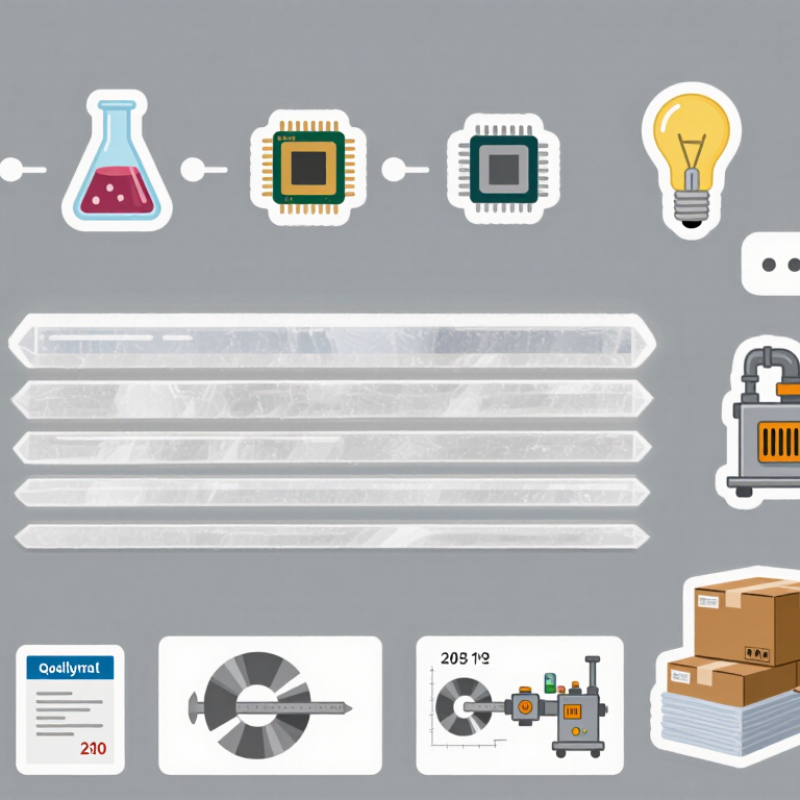
Quartz Rod Fundamentals: Fused Silica with 99.99% SiO₂ Purity
For global buyers, quartz rod fundamentals begin with fused silica, not marketing claims. Fused silica is amorphous SiO₂ produced by melting high-purity feedstock. At 99.99% SiO₂, the nominal impurity ceiling is about 100 ppm. That sounds precise. It is not complete.
The NIST Chemistry WebBook places silica’s melting transition near 1,710°C, explaining its use in high-temperature tubes, lamps, laboratory assemblies, and semiconductor-related tooling. Its thermal expansion is approximately 0.55 × 10⁻⁶/K, reducing stress during rapid heating.
The USGS Mineral Commodity Summaries 2025 estimated U.S. industrial sand and gravel production at roughly 97 million metric tons in 2024. That figure covers a broad market, not quartz rods, but it shows why feedstock classification matters. High-purity quartz represents a narrower, more demanding stream. Buyers should request batch traceability, hydroxyl content, bubble and inclusion limits, straightness, diameter tolerance, and surface finish. A rod can meet 99.99% purity yet fail a sealing or optical application.
In practical inspection, I would compare certificates with dimensional measurements and a visual light check. Ask how purity was tested. Ask again.
Different methods can measure different impurity panels, and the 99.99% figure may be rounded. For UV service, transmission data and hydroxyl control deserve special attention.
For furnace use, thermal shock history matters. An honest specification includes limits, test methods, sampling plans, and storage conditions—not only a large purity number.
Key Specifications: 1,683°C Softening Point, OH Content, and Tolerances
For global buyers, choosing a quartz rod supplier requires more than comparing prices. The 1,683°C softening point is a key reference for fused silica performance. It is not a recommended working temperature. Actual service conditions depend on heating rate, load, atmosphere, and rod geometry. A dependable supplier should provide material data, batch identification, and traceable inspection records.
OH content deserves close attention. Hydroxyl groups can affect infrared transmission, thermal behavior, and performance in demanding optical or laboratory applications. Lower OH is often preferred, but not every application needs the lowest value. Buyers should request the measured result in ppm, the testing method, and the acceptable range. I have seen specifications that looked impressive but lacked test conditions. That gap matters.
Dimensional tolerances also influence installation and performance. Diameter, length, straightness, surface finish, and end condition should be listed separately. For example, a tight diameter tolerance may support stable fitting, while a rough end can create handling problems. Tolerances must match the customer’s equipment, not simply appear narrow on paper. Sample inspection with calipers, optical tools, or a coordinate system can reveal variation between batches. Yet inspection is not perfect. I still recommend checking several rods from different cartons, because one approved sample cannot represent a full shipment. A reliable supplier responds clearly when results fall outside the agreed specification.
Key Quartz Rod Specifications for Global Buyers
The chart shows widely used reference specifications for fused quartz rods: a softening point of approximately 1,683°C, low-OH quartz typically specified at ≤10 ppm, and a representative diameter tolerance of ±0.10 mm for precision stock. Actual OH content and dimensional tolerances depend on the grade, diameter, manufacturing process, and inspection agreement.
China Supplier Evaluation: Manufacturing Capacity, ISO Systems, and QA Data
China Best Quartz Rods Supplier for Global Buyers?
A reliable quartz rod supplier should prove capacity with records, not photographs. Ask for furnace numbers, rod diameter ranges, maximum lengths, and recent monthly output. Production planning should show how urgent orders affect lead times. In practice, a supplier with several furnaces may still face bottlenecks during maintenance. Capacity is more than equipment count.
ISO systems deserve close examination. Request the current certificate, covered production scope, audit date, and document-control procedure. Then compare these details with actual factory practice. Are operators using controlled work instructions? Are measuring tools calibrated? Can staff trace one rod to its batch, furnace, operator, and inspection report? These small links reveal system maturity. A certificate alone is not enough.
QA data should include dimensions, surface condition, bubbles, inclusions, purity, and hydroxyl content when required. Request sample reports from different production lots. Check whether values include units, test methods, acceptance limits, and inspector approval. Ask for retained samples and a process for handling nonconforming rods. The data should be specific. Vague “qualified” statements provide little protection. I have seen inspection sheets with perfect numbers but weak traceability. That gap needs discussion before purchasing. A supplier may also admit where records remain manual or incomplete. Honest limitations are easier to manage than polished, unsupported claims.
Global Buyer Checklist: Testing, Traceability, Packaging, and Compliance
Choosing a quartz rod supplier requires more than comparing diameter, purity, and price. Global buyers should request test data for every production batch. Useful records may include dimensional tolerance, hydroxyl content, thermal shock performance, and surface defects. Ask whether testing uses calibrated instruments and documented methods. A certificate without test conditions is weak evidence.
Traceability should connect each rod to raw material, furnace batch, inspection date, and packing record. In my purchasing reviews, clear batch codes have prevented costly mix-ups. However, paperwork can still contain errors. Check whether the supplier can correct records quickly and explain deviations honestly. Packaging also deserves close attention. Individual sleeves, cushioned separators, moisture control, and reinforced cartons can reduce scratches and breakage during long-distance transport.
Tips: Request sample packaging before ordering. Verify labels against the purchase order. Confirm applicable import, material-safety, and product standards for your destination. Compliance claims should match the actual grade and intended use, not a generic template. Ask for declarations, inspection reports, and retention periods for quality records. A dependable supplier welcomes reasonable audits and provides consistent answers across sales, engineering, and quality teams. That consistency matters.
Supplier Comparison: MOQ, Lead Time, Incoterms, and Total Landed Cost
China Best Quartz Rods Supplier for Global Buyers?
MOQ, lead time, Incoterms, and landed cost reveal more than the quoted rod price. A low MOQ can help new buyers test quality, but it often increases unit cost and packaging charges. Standard quartz rods may ship within 10–20 working days, while custom diameters can require longer production planning. Ask for inspection records, dimensional tolerances, and recent sample results. Small details matter.
Incoterms change the buyer’s risk. Under EXW, the buyer usually manages export handling, freight, and customs clearance. FCA can provide clearer handover control. DDP may simplify delivery, but taxes and import responsibilities need careful verification. The ICC Incoterms 2020 framework defines these obligations, not the supplier’s marketing language. Do not compare offers without matching the same term.
Calculate total landed cost, not just the factory quote. Include rods, export packing, inland transport, freight, insurance, duties, brokerage, and possible storage. The World Bank Logistics Performance Index 2023 shows meaningful differences in customs and shipment reliability across markets. UNCTAD’s Review of Maritime Transport also confirms the continued importance of ocean freight in global trade. A practical comparison can still be imperfect. Freight rates change quickly, and one delayed container can erase a small price advantage. Ask suppliers for a validity period and a documented lead-time commitment.


