Get an instant quote
Get in touch Listen to our podcast

Blog

7 Best Cleanroom Dehumidifiers for Global Buyers

Selecting the right Cleanroom Dehumidifier can protect product quality, equipment, and process stability across demanding facilities. In pharmaceutical, semiconductor, medical device, and laboratory environments, humidity control is not a cosmetic improvement. It influences static electricity, condensation, microbial risk, powder behavior, and sensitive materials. A small reading error can become an expensive production problem.

This guide examines seven leading dehumidifier options for global buyers. Each model is considered through practical criteria, including moisture-removal capacity, dew-point performance, airflow control, filtration compatibility, energy use, noise, service access, and regional support. Experienced engineers also inspect installation conditions, because a powerful unit may perform poorly when ductwork, insulation, or room pressure is inadequate. Details matter. A wet loading area can undermine a carefully controlled chamber.

The comparison reflects technical principles and real purchasing concerns, not promotional claims alone. Buyers should verify test methods, operating temperatures, control accuracy, and certification documents with manufacturers. Ask for evidence. Product data can vary between laboratory conditions and daily operation. That gap deserves attention.

No machine fits every cleanroom. A desiccant system may suit ultra-low humidity requirements, while a refrigeration-based design may offer simpler operation in moderate conditions. Maintenance time, replacement parts, voltage, and local technician availability also affect long-term value. These factors are easy to overlook.

The selections are not absolute winners. They provide a practical starting point for evaluation. Final decisions should follow a qualified HVAC assessment, cleanroom classification requirements, and documented validation procedures. Oversight remains essential.
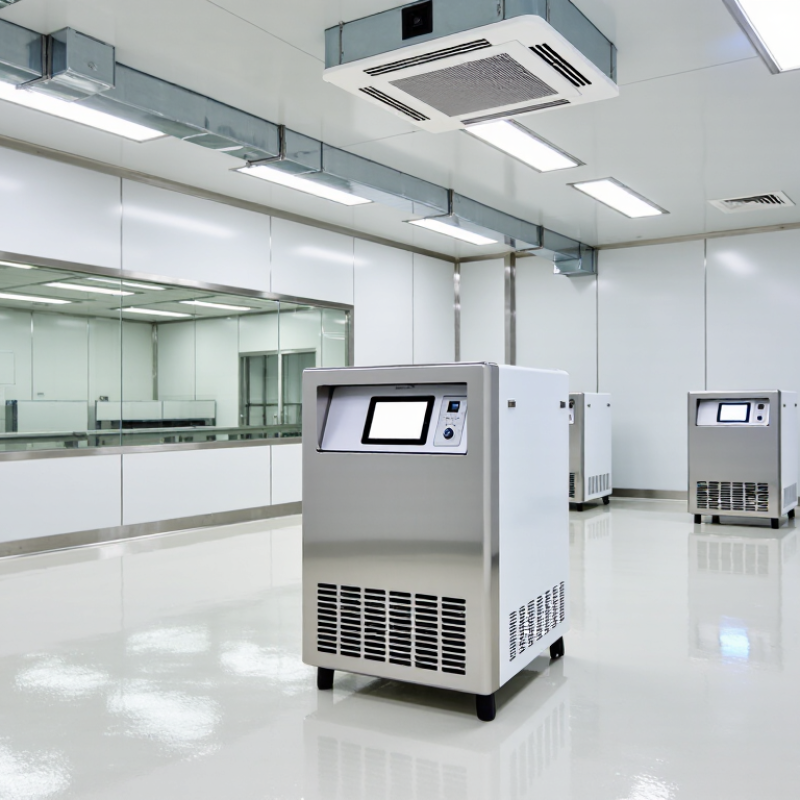
7 Best Cleanroom Dehumidifiers for Global Buyers

Cleanroom Humidity Fundamentals: 30–60% RH and ISO 14644-1 Particle Classes

Cleanroom humidity is not a decorative number on a wall display. For many facilities, 30–60% RH is a practical operating range for materials, personnel comfort, and static-control planning. Actual limits depend on the process, room temperature, and product sensitivity. Some sterile or moisture-sensitive operations require a much tighter band. That detail matters.

ISO 14644-1 defines cleanroom classes through airborne particle concentrations, not humidity. For example, ISO Class 5 permits up to 3,520 particles per cubic metre at 0.5 micrometres. A room can meet this particle class and still suffer condensation, corrosion, or electrostatic discharge.

Particle risk rises when doors open, garments shed fibers, or airflow becomes unbalanced. Measure particles under the required occupancy state, while logging temperature and RH continuously.

Never trust one sensor. Place calibrated probes near work zones, returns, and moisture entry points.

When comparing cleanroom dehumidifiers, calculate latent loads from outdoor air, infiltration, people, cleaning, and process equipment. Select capacity at the actual entering-air condition, rather than using a headline rating.

Desiccant systems can support low dew points, while cooling-based units may suit moderate humidity control. Both options need cleanable surfaces, stable controls, and accessible maintenance areas.

A common design shortcut is sizing for average weather. Peak seasonal moisture can overwhelm an undersized unit.

Review alarms, sensor drift, condensate handling, and recovery time after door openings before approval. These checks are unglamorous, but they prevent expensive surprises.

Dew-Point and Moisture-Load Sizing: ACH, Latent Heat, and 24/7 Duty

7 Best Cleanroom Dehumidifiers for Global Buyers

Dew-point control starts with the process, not the equipment catalogue. ISO 14644-1:2015 classifies airborne particles, but it does not set one universal humidity target. Product specifications, material sensitivity, and static-control requirements must guide the design. ASHRAE Handbook—Fundamentals (2021) recommends psychrometric analysis for calculating moisture removal, rather than relying only on room volume.

ACH estimates airflow, not dehumidification capacity. Calculate supply airflow from the room volume and required air changes per hour. Then identify moisture entering through people, doors, outdoor air, cleaning, and wet processes. The latent load can be estimated with Q = ṁ × Δh. At typical room conditions, removing one kilogram of water requires roughly 2,400–2,500 kJ of latent energy. Dew point matters more than relative humidity when cold surfaces or hygroscopic materials are involved.

A 24/7 cleanroom needs more than a peak-capacity rating. Check continuous-duty performance, low-load stability, coil frost control, filter pressure drop, sensor calibration, and restart behavior. Redundancy is often sensible. Still, oversizing can cause short cycling and unstable humidity. That trade-off is easy to underestimate.

Tips: Add door-opening tests to the moisture model. Verify actual dew point during commissioning, not only relative humidity. Review seasonal outdoor-air data for each destination. ASHRAE climate data helps, but local operating records are better. A practical mistake remains possible: the calculated load may be correct, while the real process load changes after production begins.

Seven Best Cleanroom Dehumidifier Types Compared by L/s and RH Control

Seven cleanroom dehumidifier types differ sharply in airflow, moisture removal, and RH stability. Airflow is measured in L/s, while moisture capacity is usually rated in kg/h. These figures should never be treated as interchangeable. A 500 L/s unit may move air efficiently but still miss a low dew-point target.

Refrigerant dehumidifiers suit moderate cleanrooms requiring about 200–2,000 L/s and 45–60% RH. Heat-pump systems offer similar airflow with better energy recovery. Desiccant wheel units typically handle 500–10,000 L/s and can maintain 10–30% RH. Twin-tower desiccant systems work well below 10% RH, especially where continuous dry air matters. Membrane dehumidifiers use roughly 50–1,000 L/s and support compact process zones. Liquid desiccant systems provide 500–5,000 L/s, with stable control around 20–40% RH. Fixed-bed adsorption units can reach 100–3,000 L/s and very low dew points, but regeneration demand is substantial.

Measure the dew point. A cleanroom engineer should check supply-air temperature, leakage, filter pressure, and room recovery time. A practical test uses a calibrated hygrometer near the critical work surface, not only inside the air-handling unit. I have seen systems hold 25% RH at the sensor while corners stayed noticeably drier. That result was acceptable on paper, but not in operation. Control loops also need enough response speed for door openings and material transfers. Keep filters accessible. Maintenance access is often underestimated, and that small mistake can weaken RH control before anyone notices.

7 Best Cleanroom Dehumidifiers for Global Buyers - Seven Best Cleanroom Dehumidifier Types Compared by L/s and RH Control
Rank Dehumidifier Type Typical Airflow Practical RH Control Range Typical Supply-Air Dew Point Typical Moisture Removal Capacity Energy and Operating Profile Best Cleanroom Applications
1 Desiccant Rotor Dehumidifier 500–20,000 L/s 10–30% RH −40 to +10 °C Approximately 5–500 kg/h Uses a continuously rotating desiccant wheel and regeneration heat. Suitable for stable, low-humidity operation, but regeneration energy must be considered. Pharmaceutical manufacturing, battery production, precision electronics, medical-device assembly, and low-dew-point environments.
2 Hybrid Desiccant and DX System 500–15,000 L/s 20–40% RH −20 to +10 °C Approximately 5–400 kg/h Combines cooling-based moisture removal with desiccant drying. Provides a practical balance between humidity control, energy use, and low dew-point capability. General cleanrooms, sterile processing areas, pharmaceutical packaging, and facilities with varying latent loads.
3 Low-Temperature Desiccant Dehumidifier 300–10,000 L/s 10–30% RH −40 to 0 °C Approximately 3–250 kg/h Designed for very dry air and cold-process conditions. It maintains dehumidification performance when conventional refrigeration systems lose effectiveness. Lithium-ion battery rooms, dry rooms, moisture-sensitive materials, and temperature-controlled production zones.
4 Refrigerant or DX Dehumidifier 300–20,000 L/s 40–60% RH +5 to +15 °C Approximately 5–300 kg/h Condenses moisture on a cooled coil. Usually offers favorable energy efficiency at moderate humidity and normal cleanroom temperatures. Warehousing, component preparation, non-sterile production, laboratories, and cleanrooms with moderate RH requirements.
5 Heat-Pump Dehumidifier 200–8,000 L/s 40–60% RH +5 to +15 °C Approximately 2–100 kg/h Recovers condenser heat to improve overall efficiency. Best where the room can accept or benefit from sensible heat released during drying. Small and medium cleanrooms, laboratories, storage areas, and facilities seeking lower operating costs at moderate RH levels.
6 Liquid Desiccant Dehumidifier 500–10,000 L/s 20–45% RH −10 to +10 °C Approximately 5–300 kg/h Uses a hygroscopic liquid solution to absorb moisture and a regeneration stage to restore the solution. It can handle high latent loads and outdoor-air treatment. Large air-handling systems, pharmaceutical facilities, hospitals, and cleanrooms with substantial ventilation requirements.
7 Compressed-Air Desiccant Dryer 50–2,000 L/s 1–20% RH −40 to −70 °C Approximately 0.5–50 kg/h Provides extremely dry process air through adsorption. It is generally intended for dedicated process-air lines rather than whole-room humidity control. Instrument air, pharmaceutical process equipment, semiconductor tools, powder handling, and moisture-sensitive manufacturing processes.
Selection note: Airflow values are typical engineering ranges for packaged or modular systems, expressed in actual cubic metres per second converted to litres per second. Actual performance depends on inlet temperature, entering RH, outdoor-air percentage, filtration pressure drop, regeneration heat, room leakage, and required cleanliness classification. RH values represent practical control ranges rather than guaranteed performance for every installation.

Global Buyer Standards: CE, UL, IEC 60335, and 50/60-Hz Compatibility

7 Best Cleanroom Dehumidifiers for Global Buyers

Global Buyer Standards: CE, UL, IEC 60335, and 50/60-Hz Compatibility

Selecting among the seven best cleanroom dehumidifiers requires more than comparing moisture-removal capacity. Buyers should verify CE documentation, electrical test reports, and the exact product configuration. CE indicates conformity with applicable European requirements, but it is not a universal quality guarantee. Documentation matters.

UL recognition can support procurement for North American facilities, especially when safety files are reviewed by inspectors or insurers. However, buyers should confirm the applicable UL standard and certification scope. A unit may carry a valid mark while optional controls remain outside that approval. Do not guess.

IEC 60335 addresses safety for household and similar electrical appliances. Its relevance depends on the dehumidifier’s design, installation, and intended environment. Industrial cleanrooms may require additional evaluation, especially for controls, wiring, condensate handling, and accessible surfaces. Ask for the declaration, test report, and current manual.

Frequency compatibility is equally practical. A 50 Hz unit may not operate correctly on a 60 Hz supply, even when voltage appears suitable. Check the nameplate, motor rating, compressor requirements, plug type, and phase configuration. Some systems accept both 50 and 60 Hz, but that claim should appear in technical documents. I have seen purchasing teams overlook this detail. It can delay commissioning. A strong shortlist also considers stable humidity control, cleanable panels, low particle release, alarms, spare parts, and service support. A perfect choice is rarely perfect everywhere.

Validation Metrics: ISO 14644-3 Testing, Alarms, Maintenance, and Energy Use

7 Best Cleanroom Dehumidifiers for Global Buyers

Validation should begin with the room, not the equipment brochure. ISO 14644-3 offers practical methods for checking cleanliness, airflow, pressure, and recovery performance. However, it does not certify a dehumidifier by itself. Test the installed system under realistic loads, including door openings, personnel, and process heat. Record temperature, relative humidity, dew point, and recovery time at several locations.

Alarms need clear limits and fast visibility. Use independent high-humidity, low-temperature, condensate, airflow, and sensor-failure alarms. Check alarm response during commissioning, not only during annual reviews. Calibrated sensors matter. A small measurement error can hide condensation risk near cold surfaces. Data logging should show trends, acknowledgments, and repeated deviations.

Maintenance evidence separates reliable units from attractive specifications. Inspect filters, coils, drains, seals, and desiccant assemblies according to operating conditions. Document pressure drop, coil cleanliness, sensor calibration, and drain performance. Energy use deserves equal attention. Measure kilowatt-hours against moisture removed, operating hours, and room load. Variable operation may reduce waste, but frequent cycling can weaken humidity stability. That trade-off is easy to miss. I would also repeat testing after major maintenance, because a clean component does not guarantee unchanged room performance.

7 Best Cleanroom Dehumidifiers for Global Buyers

Reference comparison using ISO 14644-3 validation readiness, alarm coverage, maintenance demand, and energy use.

The chart uses an anonymous engineering benchmark for seven common cleanroom dehumidifier configurations. Energy use is shown as specific energy consumption in kWh per kilogram of moisture removed; lower values indicate better efficiency. The validation score is based on documented airflow, temperature, humidity, recovery, alarm, and leakage test procedures aligned with ISO 14644-3. Alarm coverage represents the percentage of critical conditions monitored, while maintenance burden indicates estimated planned service hours per year.

CNC machining CAD export file formats

Put your parts in production today

Get an instant quote